From Zoology to Software Engineer: My Full Story
· 10 min read
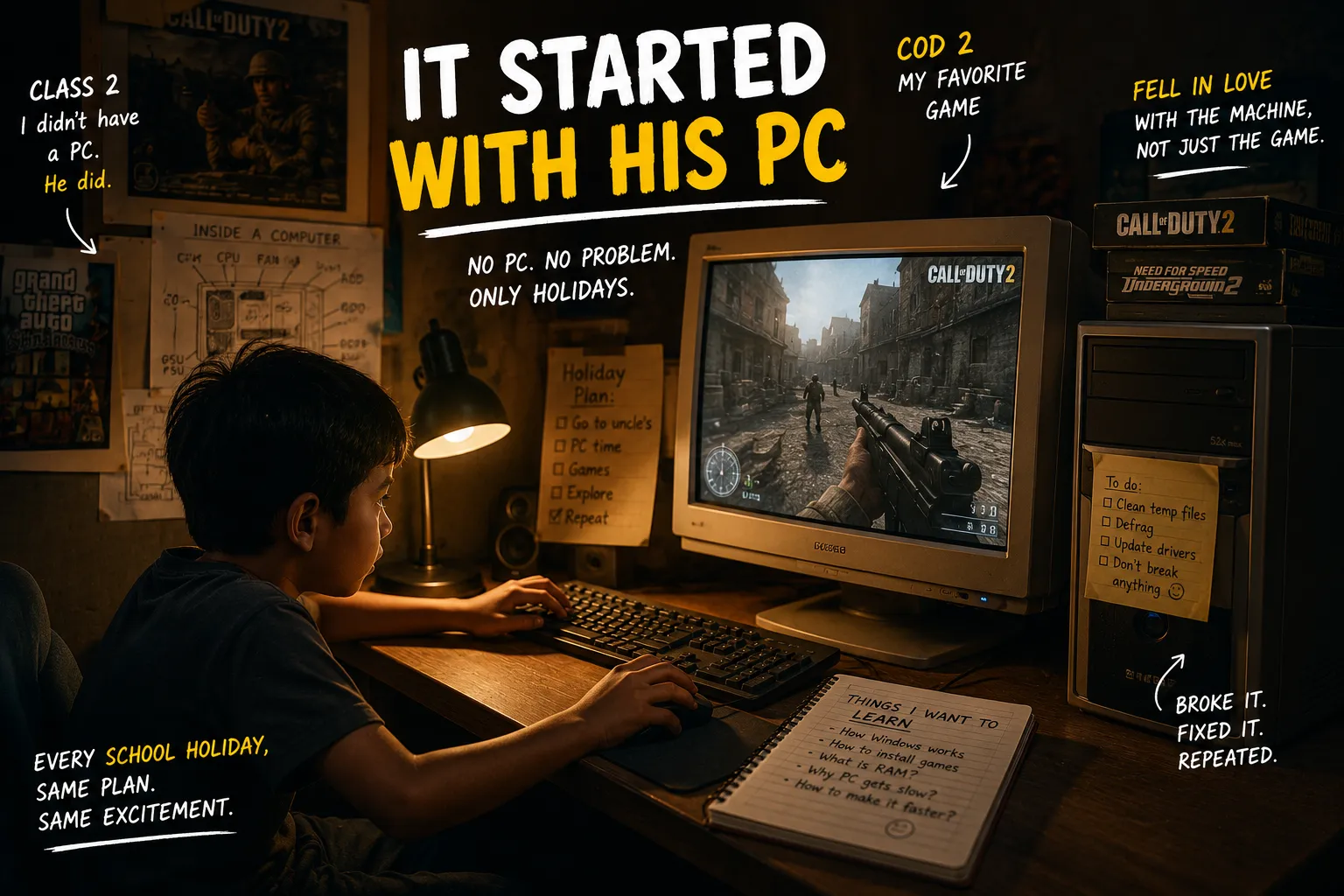
I learned to type on my uncle's desktop in class 2. He had a PC, I didn't, and that one fact decided a lot of what came after. I'd play COD 2 on it every chance I got, and somewhere between respawns I fell in love with the machine itself, not just the game. Every school holiday after that, the plan was the same: get to my uncle's house, turn on the PC, and either play something or poke around the settings until I broke something and had to figure out how to fix it.
That's the honest starting point of this story. Not a bootcamp, not a CS degree, not a clean narrative. A kid who didn't own a computer, waiting for holidays to use one.
Switching to Geography for Classes 8, 9, and 10
My school actually offered computer science as a subject. But for classes 8, 9, and 10, I switched to Geography instead. So the CS path I could have been on since class 8 wasn't the one I actually took.
I still didn't own a PC through all of school. I used to borrow my friend's laptop whenever I needed to actually sit down and use one properly. Looking back, that gap — wanting to build things but not having consistent access to a machine, and not being on the CS track during those years — probably shaped how resourceful I had to get later. You learn to make the most of borrowed time on borrowed hardware.
When HS ended, it was time to pick a bachelor's degree. I don't have a satisfying answer for why I chose Zoology Honours. It wasn't a calculated career move. It was one of those decisions you make at eighteen without really knowing what you're deciding. I completed my bachelor's in Zoology. On paper, that's about as far from "software engineer" as you can get.
Guwahati, Job Hunting, and Depression
After graduating, real life shows up whether you're ready or not. I moved to Guwahati looking for work. I didn't have a technical degree, I didn't have a portfolio, and I didn't have a clear direction. What I had was a Zoology degree that wasn't opening the doors I needed and a growing sense that I'd wasted the years that were supposed to prepare me for this moment.
That period is where depression hit. I'm not going to dress that up or turn it into a neat lesson with a bow on it. It was a hard stretch — uncertain, directionless, and heavier than I expected. I'm including it here because leaving it out would make the rest of this story sound easier than it actually was. If you're in a version of that stretch right now, I'm not going to pretend I have a formula that fixes it. What I can tell you is what I actually did next, for whatever that's worth.
Freelancing, an SMMA, and Zero Results
I already knew how to build a website on WordPress with Elementor, so freelancing felt like the obvious next move. A close friend and I started a social media marketing agency after watching a bunch of YouTube videos on how to do it.
It produced nothing. No clients worth mentioning, no traction, no results. I'm not going to inflate that into a "failed startup" with a lesson attached. It was two people with no network, no proof of work, and no real go-to-market plan, trying to sell a service neither of us had actually delivered before. That's it. It didn't work, and it didn't work for reasons that are obvious in hindsight.
Finding Dan Koe and Actually Building a Skill
At some point in that mess, I came across Dan Koe's content on YouTube. What stuck with me wasn't any single video, it was the repeated idea that you build a skill first, monetize it second, and structure your life around a business of one instead of chasing a job that was never going to fit the way you think.
That's when I started actually looking for my Ikigai instead of just reacting to whatever opportunity showed up next. I want to be careful here, because "I found my purpose" can sound like a slogan. What it actually meant, practically, was narrowing down from "I like computers" to "I'm going to learn to build software, specifically." That's a small shift on paper. It changed everything that came after.
I was lost, the same way a lot of people reading this probably are right now. I'd already spent years not knowing what I was doing with my life. The difference wasn't some sudden clarity. It was picking one direction — coding — and actually committing hours to it instead of drifting between ideas.
Coding Ninjas, Leaving, and Trying Again With an MCA
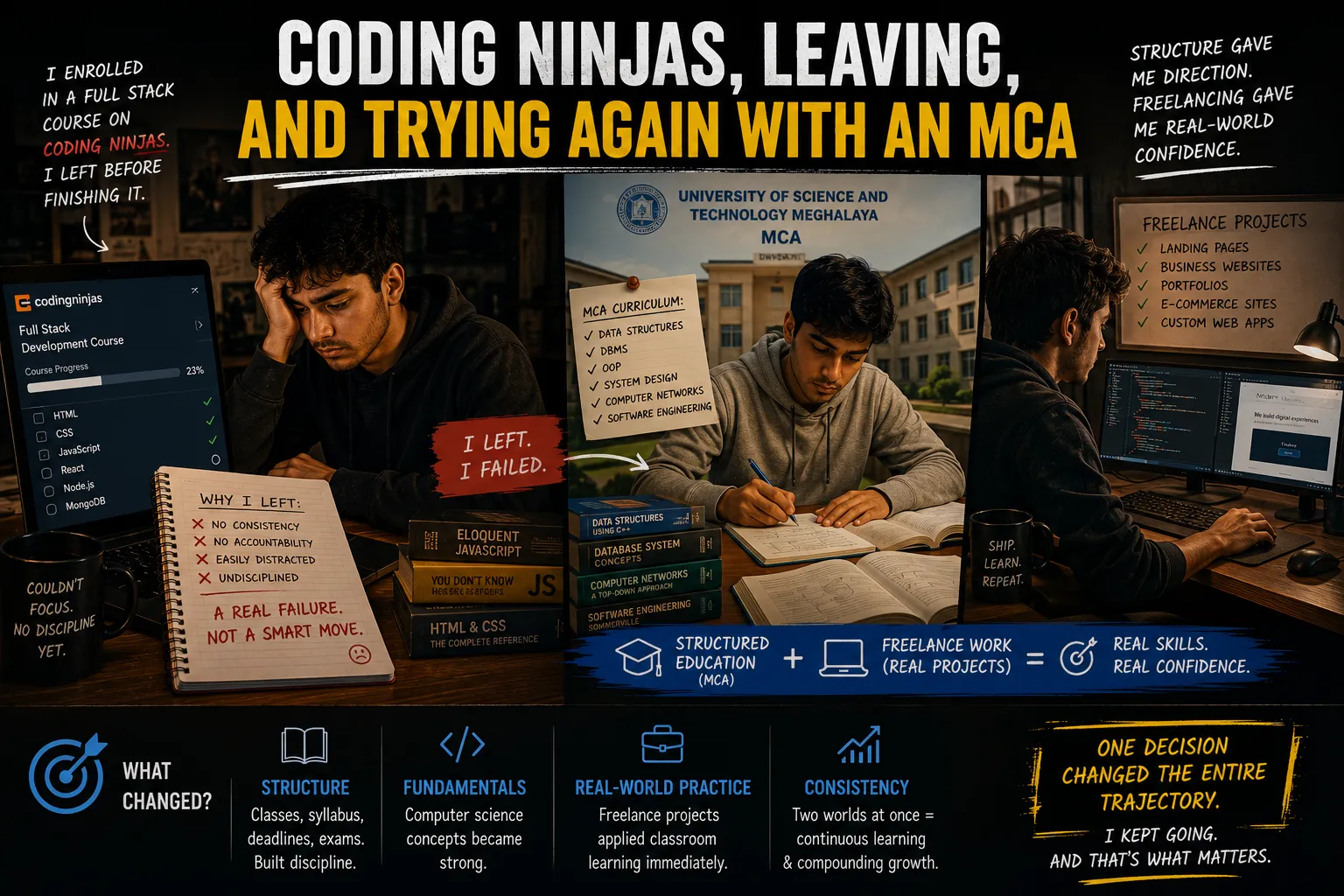
I enrolled in a Full Stack Development course on Coding Ninjas. I left before finishing it. I couldn't focus, plain and simple. Self-paced online courses ask for a kind of discipline that I didn't have yet at that point, and I'm not going to pretend that dropout was secretly a smart move. It was a real failure to finish something I'd started.
What actually got me consistent was going back into structured education: I pursued an MCA at University of Science and Technology Meghalaya. While doing that, I kept taking on freelance web development jobs on the side, which meant I was learning the formal computer science fundamentals in class and immediately testing them against real client problems outside of it. That combination — structured coursework plus paid freelance work happening at the same time — did more for my actual skill level than either one would have done alone.
NIC, an Agency, and Teaching: Testing Different Rooms
After the MCA, I moved through a few different environments, and each one taught me something different about what kind of engineer I actually wanted to be.
I landed a Software Engineer Intern role at NIC, MeitY, where I built an AI-powered Meeting Management System that ended up being used by 50 to 100 district office staff. That was my first real exposure to building software that had to work for actual government users, not a demo audience. Government software has constraints most tutorials never mention: legacy systems, non-technical end users, and zero tolerance for downtime during a live meeting.
From there I worked as an Associate Software Engineer at an agency, MetaMorphose, leading development on 5+ client web apps using React and Node.js. Agency work is a different discipline entirely — you're not building your own vision, you're translating someone else's business problem into working software on their timeline, often with requirements that shift mid-project.
I also spent time as a computer science teacher at a college, Auxilium College Udalguri, before all of this. Teaching forces you to actually understand something well enough to explain it to someone who's seeing it for the first time. It's one of the most underrated ways to find the gaps in your own knowledge.
I later did a remote Software Engineer Fellowship with Headstarter AI, working with a US-based team, which was my first real experience with fully remote, asynchronous collaboration across time zones.
Each of these was a different room: government, agency, classroom, remote startup team. None of them was the "right" one in some final sense. They were data points that helped me figure out what I actually wanted to build and how.
Where I Am Now: MIS and Data Analyst on a Rural Development Programme
Here's the part that surprises people most: I'm currently working as an MIS & Data Analyst at Citizens Foundation, on the Holistic Rural Development Programme in Sagalee Block, Papum Pare District, Arunachal Pradesh, funded by HDFC Bank Parivartan.
It's about as far from a typical "software engineer" job title as you can get, and that's exactly why it's been useful. I built Python automation scripts that cut manual reporting effort by roughly half across more than a dozen programme components. Nobody there cares whether your code is clever. They care whether the report that used to take three people two days now takes one script twenty minutes. That's a different kind of pressure test for your engineering than a coding interview ever is.
Working in a remote part of Arunachal Pradesh on a development programme also changes how you think about software. You're not optimizing for engagement metrics or growth loops. You're optimizing for whether a field officer with patchy connectivity can actually submit their data without the system falling over.
Building CreatorBit and Ganlary Labs Alongside a Full-Time Job
None of the above is a side note to the "real" story. It's the reason the next part exists at all.
Despite having a full-time role at Citizens Foundation, I'm building two things on the side: CreatorBit and Ganlary Labs.
CreatorBit is a SaaS platform for the creator economy, built on Next.js, Supabase, and the Claude API. It's the project where I get to make my own architecture decisions instead of inheriting someone else's, and where every bug or scaling problem is one I have to solve myself, on my own time, after a full day of HRDP work. There's no team backstopping me on this one. If something breaks in production, that's evenings and weekends, not office hours.
Ganlary Labs is my freelance venture, where I take on SaaS MVP builds, AI feature integration work, and small business websites. This is the direct continuation of that early WordPress and Elementor freelancing, except now it's backed by an actual engineering background instead of just knowing how to drag components around a page builder.
Why do both of these alongside a day job instead of picking one lane? Honestly, it's a mix of reasons, and I don't think there's one clean answer. The full-time role at Citizens Foundation is stable, meaningful, and pays the bills; rural development work matters to me and I'm not interested in walking away from it just to chase a startup fantasy. But CreatorBit and Ganlary Labs are where I get to own outcomes end-to-end, ship things nobody assigned me, and build the kind of long-term leverage a salary alone doesn't give you.
It's also just a lot of hours. I'm not going to pretend building two things on the side of a full-time job is sustainable forever without trade-offs. Some weeks the freelance clients through Ganlary Labs get priority because there's a deadline. Some weeks CreatorBit gets the attention because I'm mid-feature and don't want to lose the thread. The HRDP work always gets its hours first, because that's the commitment I made and the one that pays the bills reliably. Everything else fits in around it.
What I'd Actually Tell Someone Who Feels Lost Right Now
I'm not going to wrap this up with a motivational line about finding your purpose, because that's exactly the kind of language that used to bounce off me when I was in the middle of it.
What I can say, concretely, is this: the zoology degree wasn't wasted, even though it felt like a dead end at the time. The failed SMMA wasn't wasted, even though it produced zero results. The Coding Ninjas course I dropped wasn't wasted, even though I didn't finish it. Every one of those became either a skill, a lesson about my own discipline, or a clearer sense of what I didn't want to keep doing. None of that was visible while I was in it. It only became visible in hindsight, once there was enough distance to look back and connect the pieces.
If you're currently stuck between what you studied and what you actually want to build, you don't need the whole path mapped out. You need the next skill, and enough hours logged in it to know if it's actually for you. That's what changing from Biology to a full stack developer looked like for me in practice: not one big leap, but a long series of unglamorous, sometimes failed attempts that eventually compounded.
For more on the building-in-public side of what I'm doing right now, see more Building in Public posts.
FAQ
Frequently asked questions
How did Jenarius Ganlary go from a Zoology degree to software engineering?
His school offered computer science, but he switched to Geography for classes 8, 9, and 10. He later completed a Bachelor's in Zoology Honours. After struggling to find direction and going through a period of depression while job hunting in Guwahati, he discovered Dan Koe's content on building a skill and monetizing it, which led him to pursue an MCA in Computer Science and take on freelance web development work alongside it.
What is CreatorBit?
CreatorBit is a SaaS platform for the creator economy built on Next.js, Supabase, and the Claude API. It's a side project being developed alongside a full-time job as an MIS & Data Analyst on a rural development programme.
What is Ganlary Labs?
Ganlary Labs is a freelance development venture focused on SaaS MVP builds, AI feature integration, and small business websites. It's a direct continuation of earlier WordPress and Elementor freelancing work, now backed by a formal computer science and full stack development background.
How does someone build a startup while working a full-time job?
By treating the full-time job's hours as non-negotiable first, then fitting freelance client work and personal projects into evenings and weekends around it. It requires accepting that some weeks one project gets more attention than another, rather than expecting to give every project equal time simultaneously.
Written by Jenarius Ganlary
Full-stack developer and MIS & Data Analyst, building CreatorBit and freelancing through Ganlary Labs. Writing about SaaS, AI, and startups as it happens.
More about me →KEEP READING