ChatGPT vs Claude for Coding: What Actually Changed
· 7 min read
I want to be upfront about something before I get into this: I'm not going to hand you a benchmark table. I went looking for one before writing this, and every "Claude vs ChatGPT 2026" comparison I found cited a different score for the exact same benchmark on the exact same model — sometimes a 10-point spread, sometimes a flat contradiction between two articles published the same week. That's not a data problem I can solve by picking the biggest number. So instead, this is the comparison I can actually stand behind: what changed in what I could trust each tool to do, across the years I've actually used both for real coding and automation work.
I started using ChatGPT early, back when it was the only thing in this category worth talking about. I picked up Claude later, once it started showing up as the default model inside the coding tools I was already using. What follows is the honest, unglamorous version of what changed — not what a vendor's benchmark page says changed.
What Early ChatGPT Actually Looked Like
The first thing that struck me about early ChatGPT wasn't that it could code — it was that it would confidently write code that looked completely correct and simply didn't work. Syntax that didn't compile. Imports for libraries that didn't exist. Logic that solved a slightly different problem than the one I'd asked about. None of this was rare. It was the default experience.
What made it genuinely useful anyway was speed of iteration. Even when the first answer was wrong, it was wrong in a way I could react to fast — paste the error back in, get a revision, repeat. For small, self-contained scripts, that loop worked well enough that the wrong-first-answer problem didn't matter much. For anything that touched a real codebase with context beyond a single file, it fell apart quickly. It simply didn't have the context window to hold enough of the actual project in view, and it had no way to go look at the rest of the codebase itself — you were the one copying and pasting the relevant pieces in and hoping you'd picked the right ones.
What Claude Looked Like When I First Tried It
By the time I actually sat down with Claude seriously, the landscape had already shifted — this wasn't me comparing two products at the same stage of maturity, it was me comparing an early tool I already had years of scar tissue with against a tool that arrived into a market that had already learned some lessons.
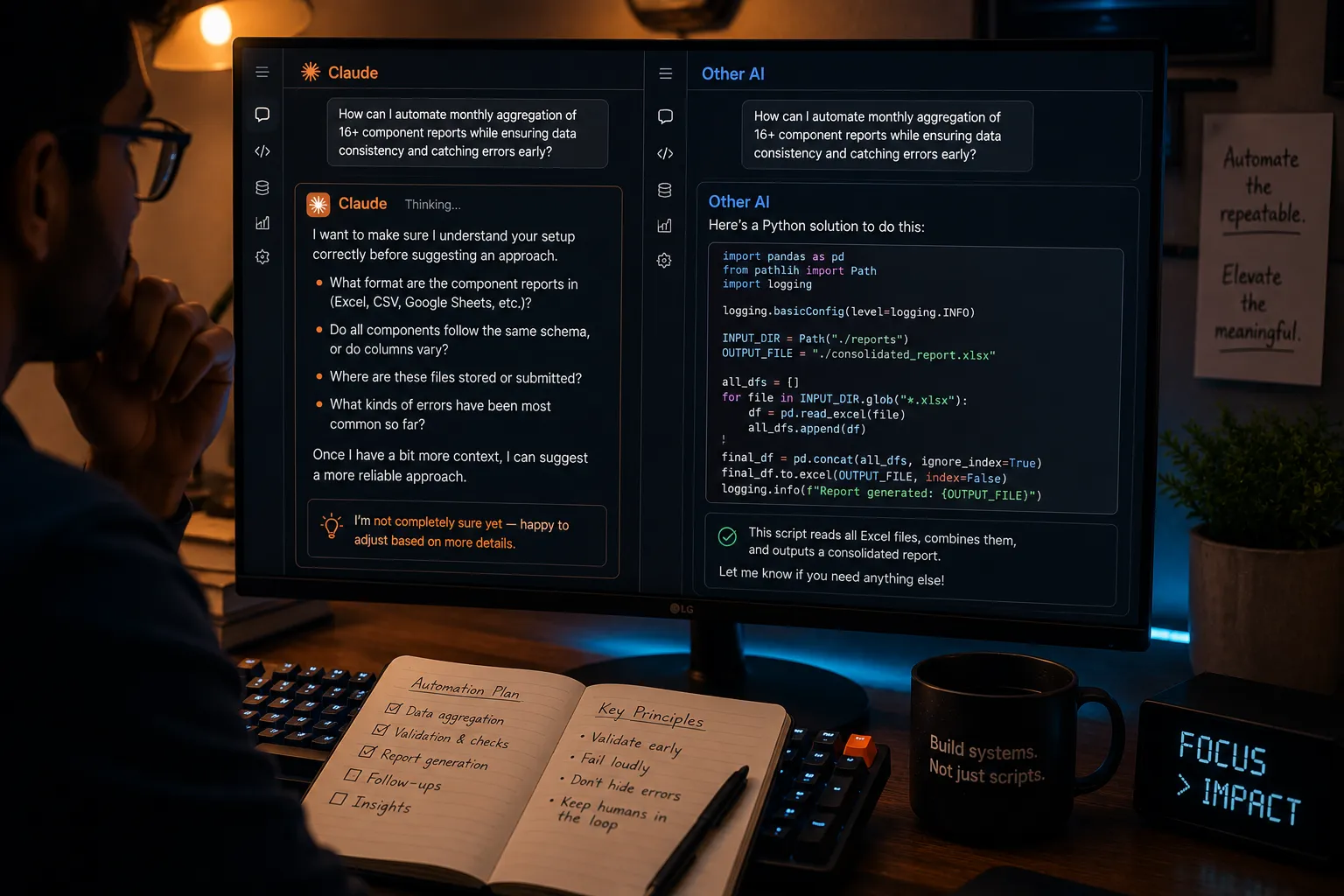
The difference I noticed immediately wasn't raw code quality — plenty of tools could write a clean function by that point. It was that Claude was less likely to state something with total confidence when it wasn't actually sure. Early ChatGPT would give you a wrong answer with the same tone as a right one. Claude, more often, would flag its own uncertainty, or ask a clarifying question instead of guessing. For automation work specifically — scripts that touch real data, real reports, things where a silent wrong answer is worse than an honest "I'm not sure" — that difference mattered more to me than raw generation speed.
Where Early ChatGPT Actually Failed Me
The clearest example I remember: an early script for cross-checking data across multiple report submissions. I asked ChatGPT to help write a validation function, and it produced something that looked entirely reasonable — right structure, sensible variable names, comments that explained what it was supposedly doing. It just handled one specific edge case wrong, in a way that wouldn't throw an error. It would silently pass bad data through as valid.
I didn't catch that on the first read. I caught it because the output looked slightly off days later, and had to trace it back manually. That's the specific failure mode that stuck with me: not that the tool got things wrong, every tool does, but that it got things wrong in ways that looked identical to getting them right. That's a much more expensive kind of mistake than a script that just crashes.
The Point Where Claude Became My Default for Code
The shift for me wasn't a single dramatic moment — it was a slow accumulation of not having to double-check things as often. Multi-file reasoning was the biggest practical difference. Being able to point a tool at an actual project and have it hold enough context to understand how one file's change affected another, instead of me manually assembling the relevant snippets myself, changed how I used AI assistance day to day. It stopped being a smarter autocomplete and started being something closer to a second person I could hand a real task to and trust to ask before assuming.
The other thing that mattered, and this is less about any specific model and more about the ecosystem around it: once terminal-based agentic tools built around Claude became genuinely usable for real project work, the entire shape of the workflow changed. I wasn't copy-pasting code between a chat window and my editor anymore. The tool was in the codebase with me.
What "More Accurate" Actually Means in Practice
If I had to define accuracy the way it actually matters for coding and automation work, it isn't "percentage of benchmark questions answered correctly." It's something closer to: how often do I have to catch a mistake myself, and how expensive is that mistake when I don't catch it in time.
By that definition, the real shift over the past couple of years — across both tools, not just one — has been less about raw capability and more about honesty under uncertainty. Early models of both kinds would guess with full confidence. Today's versions of both are far more likely to flag ambiguity, ask a clarifying question, or say a task is out of scope for what they can verify. That shift matters more for automation work than any speed improvement, because the cost of a confidently wrong script running unattended against real data is much higher than the cost of a slow one.
Where ChatGPT Has Genuinely Caught Up
I don't think it's honest to write this as a one-directional story. ChatGPT today is a different product than the one I started with, and a lot of what used to be its weak points aren't weak points anymore. Multi-file context, tool use, the ability to actually go look at a codebase instead of relying on what I pasted in — all of that has closed a gap that used to be much wider. For fast, broad prototyping across a wide range of frameworks and languages, it's genuinely strong, and I still reach for it in situations where I want quick breadth over deep, careful reasoning about one specific system.
What Hasn't Changed: The One Thing Both Still Get Wrong
Neither tool has fully solved the problem that got me in the first place: confident-sounding output that's subtly wrong in a way that doesn't announce itself. It happens less often than it used to, with both tools, but it hasn't gone away, and I don't think it's realistic to expect it to disappear entirely. The practical lesson I've taken from watching this play out over years, not months, is that the review step doesn't get to go away just because the tool got better. It just gets to be less frequent.
My Honest Verdict for Automation and Productivity Work
For the kind of work I actually do — automation scripts touching real reporting data, freelance client builds where a mistake affects someone else's business, multi-file refactors on codebases I need to understand deeply — Claude is where I default today, mainly because of how it handles uncertainty and how well it holds context across a real project rather than a pasted-in snippet. For fast, wide prototyping, quick one-off scripts, or exploring an unfamiliar framework, ChatGPT still earns a place in the rotation.
Neither of those verdicts is really about a benchmark. It's about which tool's mistakes cost me less, in the specific kind of work I actually do — and that's the question I'd tell anyone to ask instead of chasing whatever score a comparison article printed this month.
FAQ
Frequently asked questions
Is Claude more accurate than ChatGPT for coding?
In my own experience across real automation and client work, Claude has been more reliable specifically because it's more likely to flag uncertainty instead of guessing with full confidence — which matters more for real projects than any single benchmark score, since published benchmark numbers for both tools vary wildly and often contradict each other across different sources.
How has ChatGPT changed since it first launched for coding tasks?
Early ChatGPT often produced code that looked correct but had subtle, silent errors, and struggled with anything requiring context beyond a single pasted-in file. It has since gained meaningfully better multi-file context handling and tool use, closing much of the gap that used to exist for real project work rather than isolated snippets.
What's the biggest difference between using AI for coding in 2023 versus now?
The biggest shift isn't raw code generation quality — it's how AI tools handle uncertainty. Earlier models tended to answer everything with the same confident tone whether they were right or wrong. Current models are more likely to flag when something is ambiguous or ask a clarifying question, which matters most for automation work where a silently wrong answer is more costly than a slow one.
Should I use ChatGPT or Claude for automation scripts?
For automation work where a mistake affects real data or a real business outcome, prioritize whichever tool you've found asks clarifying questions and flags uncertainty rather than guessing — in my experience that's been Claude, but the more important habit is testing both against your actual use case rather than trusting a single comparison article's numbers.
Written by Jenarius Ganlary
Full-stack developer and MIS & Data Analyst, building CreatorBit and freelancing through Ganlary Labs. Writing about SaaS, AI, and startups as it happens.
More about me →KEEP READING