Best Hosting for SaaS and Web Apps in 2026 (Compared)
· 10 min read
Every few months, someone in a founder Discord posts a hosting bill that doesn't match what they budgeted for, and the thread turns into forty replies of people relitigating Vercel vs. Railway vs. "just get a VPS." I've had versions of that conversation with myself more than once while running my own SaaS on Next.js and Supabase. So instead of another ranked listicle, here's the actual decision-making I go through, plus where I've been wrong.
Why Hosting Choice Is Harder Than It Looks in 2026
The honest answer to "what's the best hosting for a SaaS app" is: it depends on which SaaS app, at which stage, with which traffic pattern. That's not a cop-out — it's the whole problem with most hosting comparison content. A post-Heroku market gave us Railway, Render, and Fly.io as the default "just deploy it" options, Vercel absorbed most of the Next.js-first crowd, and a plain VPS from DigitalOcean or Hetzner never actually went away, it just got unfashionable for a few years.
What changed by 2026 is that all of these platforms have matured into genuinely production-capable options — which is actually what makes the choice harder, not easier. Five years ago the decision was "which of these is even reliable enough." Now it's "which one fits my traffic shape, my team size, and my tolerance for surprise line items on a bill."
That last part matters more than any feature comparison. The single most common regret I hear from other indie developers isn't "I picked the wrong platform" — it's "I didn't understand how this platform bills for the thing that ended up being expensive for my app specifically." Bandwidth, background workers, database connections, and cold starts all get priced differently across these platforms, and none of it shows up clearly on a pricing page.
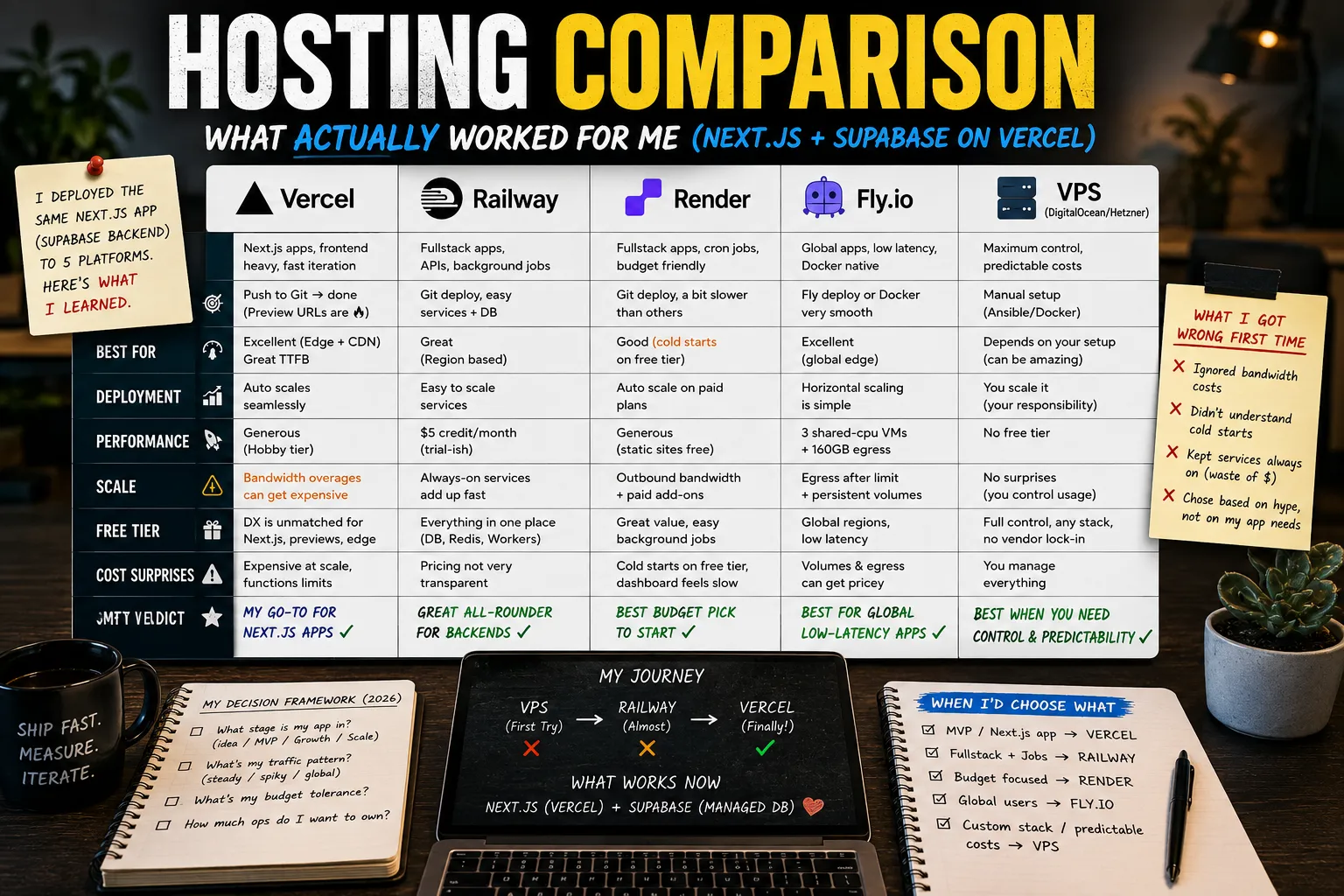
The Real Contenders
I'm narrowing this to the five options that actually come up when a solo developer or small team is choosing hosting for a SaaS or web app in 2026. There are more platforms than this, but these five cover the decision space almost everyone is actually working with.
Vercel
Vercel is still the best developer experience for a Next.js frontend, full stop. Git push, instant preview deploys, an edge network that just works, zero config for the framework it was built around. If your app is mostly a frontend with short-lived API routes, nothing else feels as smooth to build on.
The trade-off shows up once you leave the free or entry-level tier. Vercel's pricing is usage-based across bandwidth and serverless function invocations, and both of those can move in ways that are hard to predict from a marketing page. A traffic spike from a viral post, a bot crawling your site aggressively, or a feature that ships more data per request than you expected can turn a $20 month into something much larger. This isn't a hidden gotcha exactly — it's disclosed — but it's the kind of thing you only really internalize after it happens to you or to someone you know.
Vercel also isn't built for long-running processes. Background jobs, queue workers, anything that needs to sit and run rather than respond to a request, doesn't fit its model well. You end up either working around that with external services or splitting your architecture, which is a very different problem than "just deploy the app."
Best for: Next.js-first apps where the frontend is the product and backend logic stays lightweight.
Railway
Railway is the platform most indie hackers reach for first when they want something that feels like Heroku used to feel — push code, get a URL, don't think about infrastructure. It handles a full-stack app (web service, worker, database, Redis, scheduled job) inside one project without forcing you into a sprawling cloud console, and the dashboard is genuinely pleasant to use.
The honest trade-off is reliability history. Railway has had a handful of notable platform outages in the past year, which matters if you're running something that genuinely can't go down. For an early-stage SaaS or side project, that risk is usually acceptable in exchange for speed. For something closer to mission-critical, it's worth weighing seriously rather than assuming maturity by default.
Best for: full-stack apps with a database where you want managed infrastructure without a DevOps learning curve, and where development speed matters more than five-nines uptime.
Render
Render's whole pitch is "boring, predictable, reliable," and it mostly delivers on that. Flat monthly pricing instead of usage-based billing means you can actually budget for it, which is worth more than it sounds like once you've been burned by a variable bill somewhere else. Render also has a real managed Postgres story with point-in-time recovery, which matters if your database is something you can't afford to lose.
The cost of that predictability is that Render's free tier for web services spins down after a period of inactivity, and waking a service back up takes real time — long enough that a user hitting a cold app can notice. For a production app on a paid tier this isn't an issue, but it's worth knowing if you're testing on the free plan and wondering why your app feels slow the first time someone opens it each day.
Best for: developers who want flat, predictable billing and don't want to think about usage-based pricing surprises.
Fly.io
Fly.io's pitch is global distribution and low-level control — you're closer to actual VMs than most of the alternatives, which means better performance for latency-sensitive apps serving users across regions, and genuinely interesting infrastructure primitives if you want to go deep on it.
The trade-off is a steeper learning curve. Fly.io rewards Docker familiarity and a willingness to think about infrastructure more directly than Railway or Render ask you to. It's also the platform I'd watch most carefully for how actively it's being developed — a smaller, more specialized product in a market with two much better-funded competitors is worth keeping an eye on before you build critical infrastructure on it long-term.
Best for: apps with genuinely global users where latency matters, and where you're comfortable with more infrastructure control in exchange for more infrastructure responsibility.
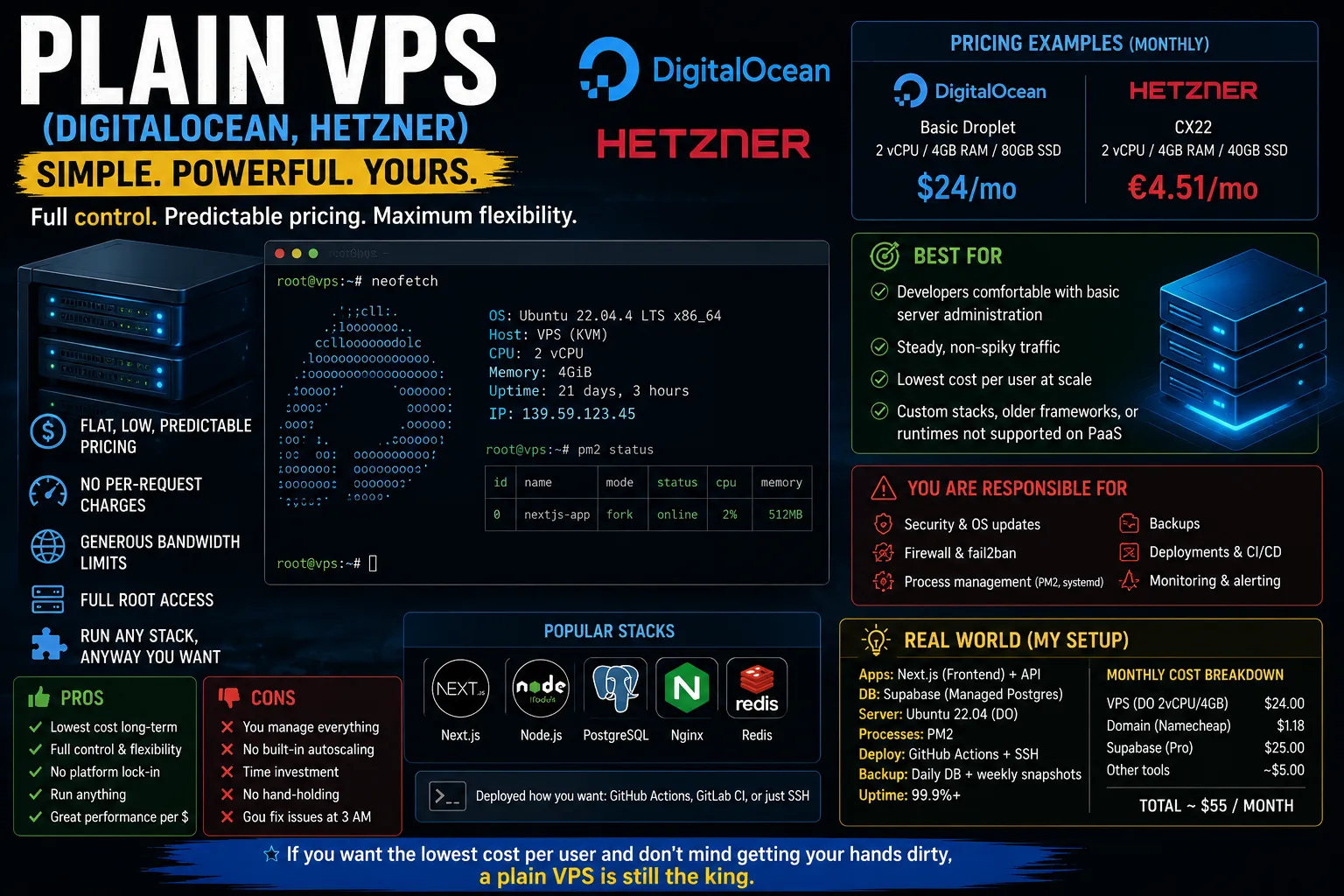
A Plain VPS (DigitalOcean, Hetzner)
This is the option that generic hosting listicles almost never take seriously, and it's the one that quietly makes the most financial sense for a specific kind of app: something with steady, non-spiky traffic where you don't need a platform's managed conveniences enough to pay for them.
A small VPS costs a flat, low, predictable amount regardless of how many users you have, as long as the server has the resources to handle them — no per-request charges, no bandwidth metering beyond a generous limit, no per-seat fees. The cost is entirely yours: you're responsible for security patching, process management, deployment scripting, and monitoring, none of which is handled for you the way it is on a PaaS.
Best for: developers comfortable with basic server administration who want the lowest cost per user at any real scale, or who are running a stack (older frameworks, specific language runtimes) that doesn't map cleanly onto a modern PaaS.
Comparison at a Glance
| Platform | Pricing model | Best fit | Real trade-off |
|---|---|---|---|
| Vercel | Usage-based (bandwidth + invocations) | Next.js frontends, light backend | Bills can spike unpredictably at scale |
| Railway | Usage-based, generous free credit | Full-stack apps, fastest to ship | Reliability history worth weighing |
| Render | Flat monthly pricing | Predictable production billing | Free tier cold starts |
| Fly.io | Usage-based, VM-level control | Global, latency-sensitive apps | Steeper learning curve |
| VPS (DO/Hetzner) | Flat, resource-based | Steady traffic, cost-sensitive | You own ops and security |
This table is a starting point, not a verdict — the right column to weight heavily depends entirely on what your app actually does.
How I'd Actually Choose, Based on Stage
Ranking platforms in the abstract is less useful than thinking about where your app is right now, because the right answer changes as you grow.
Pre-launch, just trying to ship something: don't over-engineer this decision. Whatever gets you a working URL fastest is the right call — Railway's free credit or Render's free tier are both fine here. The cost of picking "wrong" at this stage is a future migration, which is cheap when your app has no real users yet.
First real users, early traction: this is where reliability starts to matter in a way it didn't before. If people are depending on your app daily, cold starts and platform outages become actual user experience problems, not abstract risks. This is usually where I'd budget for a paid tier on Railway or Render rather than staying on a free plan, purely because the cost of downtime now has a real face attached to it.
Real traffic, production SaaS: now the billing model itself becomes a strategic decision, not just a convenience one. If your traffic is steady and predictable, a flat-rate platform or a VPS often saves real money over usage-based pricing. If your traffic is spiky or global, the platforms built for that (Fly.io, or Vercel for frontend-heavy apps) start to justify their cost. This is also the point where it's worth actually modeling your expected bandwidth and request volume against each platform's pricing structure instead of guessing.
The Mistake Most Indie Hackers Make With Hosting
The mistake isn't picking the "wrong" platform. It's not looking at the pricing model closely enough before committing, and then discovering the expensive part of your usage pattern only after a bill arrives that doesn't match expectations. Bandwidth is the quiet one — a feature that serves large files, images, or user uploads can cost far more in egress than it does in compute, and that line item rarely shows up in the "getting started" pricing examples.
The fix is boring but it works: before you commit to a platform for anything beyond a prototype, actually estimate your bandwidth and request volume for a realistic month, and price that specific scenario against each platform's calculator rather than their marketing tier. Twenty minutes of that math has saved me from a couple of decisions I would have regretted.
What I Actually Use, and Why
My own SaaS runs on Next.js with Supabase as the backend, and I've stayed on Vercel for the frontend because the deploy experience for that specific framework combination is still hard to beat — preview deploys on every branch make client and personal work genuinely faster to iterate on. I've paid attention to the bandwidth and function-invocation line items more carefully as the app has grown, because that's the part of this stack I'd actually get surprised by if I stopped watching it.
If I were starting a new full-stack side project today where the backend does more real work — background jobs, a worker process, something that isn't just responding to short HTTP requests — I'd default to Railway first, purely for how fast it gets you from zero to a working, database-backed app. I've written before about why I picked Supabase over Firebase for the database and auth layer of that same project, and the hosting decision follows a similar logic: optimize for what lets you ship and iterate fastest right now, and treat a future migration as a solvable problem rather than a reason to freeze.
There's no universally correct answer here, and I'd be skeptical of any post that gives you one with total confidence. The goal is matching the platform's actual trade-offs to your actual traffic pattern, not finding the platform with the most checkmarks on a feature comparison.
For more on the tools worth paying for as a solo developer, I wrote about that directly in 5 Tools Every Solo Developer Should Actually Pay For. And for more posts like this one, see more SaaS & AI Tools posts.
FAQ
Frequently asked questions
What is the best hosting for a SaaS app in 2026?
There isn't a single best option — it depends on your app's traffic pattern and stage. Railway or Render are the fastest way to ship a full-stack app with a database, Vercel is unmatched for Next.js-heavy frontends, Fly.io suits globally distributed and latency-sensitive apps, and a plain VPS from DigitalOcean or Hetzner is often the cheapest option for steady, predictable traffic.
Is Vercel expensive for SaaS apps?
Vercel's entry-level pricing is competitive, but its usage-based billing on bandwidth and serverless function invocations can produce unexpectedly large bills once an app has real traffic, particularly if it serves large files or experiences a traffic spike. It's worth modeling your expected bandwidth against Vercel's pricing calculator before committing an app with meaningful traffic to it.
Should I use a VPS instead of a managed hosting platform?
A VPS makes the most sense when your traffic is steady rather than spiky and you're comfortable handling basic server administration, security patching, and deployment yourself. In exchange, you get flat, predictable pricing that doesn't scale up per request or per user, which can be significantly cheaper at real scale than usage-based platforms.
Is Railway or Render better for indie hackers?
Railway is generally faster to get a full-stack app running and has a more flexible free credit, making it a common first choice for early-stage side projects. Render's flat monthly pricing and stronger managed Postgres offering make it a better fit once predictable billing and production reliability matter more than raw shipping speed.
Written by Jenarius Ganlary
Full-stack developer and MIS & Data Analyst, building CreatorBit and freelancing through Ganlary Labs. Writing about SaaS, AI, and startups as it happens.
More about me →KEEP READING