Supabase vs Firebase: Why I Picked Supabase
· 11 min read
I picked Supabase over Firebase for CreatorBit for three reasons: my data is relational and Postgres handles that natively while Firestore makes you model around it, Supabase's open-source Postgres core gives me a real exit if I ever need one, and its pricing is predictable in a way Firebase's per-operation billing is not. That's the whole decision in one sentence.
The rest of this post is the reasoning underneath it — because the one-sentence version hides the parts that were actually hard. Firebase is a genuinely good platform, better than Supabase at several things, and there were moments during the evaluation and after it where I questioned the choice. Most Supabase vs Firebase comparisons are feature tables written from nobody's perspective in particular. This is the opposite: one specific product, one solo developer, and how the criteria got weighted when it was my own app and my own on-call rotation of one.
What CreatorBit Needed From a Backend
CreatorBit is a SaaS platform for the creator economy, built on Next.js and deployed on Vercel, with AI features running on the Claude API. The backend decision came down to what that combination actually demands day to day.
The requirements list looked like most SaaS requirements lists: a database, authentication, file storage, and some server-side logic — without me operating servers, because I'm one person and the entire point of a backend platform is buying back operational time. I'd already worked through that logic for infrastructure generally in 5 Solo Developer Tools Actually Worth Paying For: as a solo developer, managed database hosting is the one subscription that's genuinely non-negotiable, because your data is the only unrebuildable part of your stack.
Both Firebase and Supabase clear that bar. Firebase has been clearing it since 2011 — it's a mature Google platform with over a dozen services around a NoSQL document database called Firestore. Supabase launched in 2020 as the open-source alternative: instead of building a proprietary database, it wraps PostgreSQL — plus open components for auth, storage, and auto-generated APIs — into a comparable hosted experience.
So the choice wasn't "which one works." Both work. The choice was about which platform's trade-offs pointed the same direction as my product. Three criteria decided it.
Relational Data Was the Real Decision
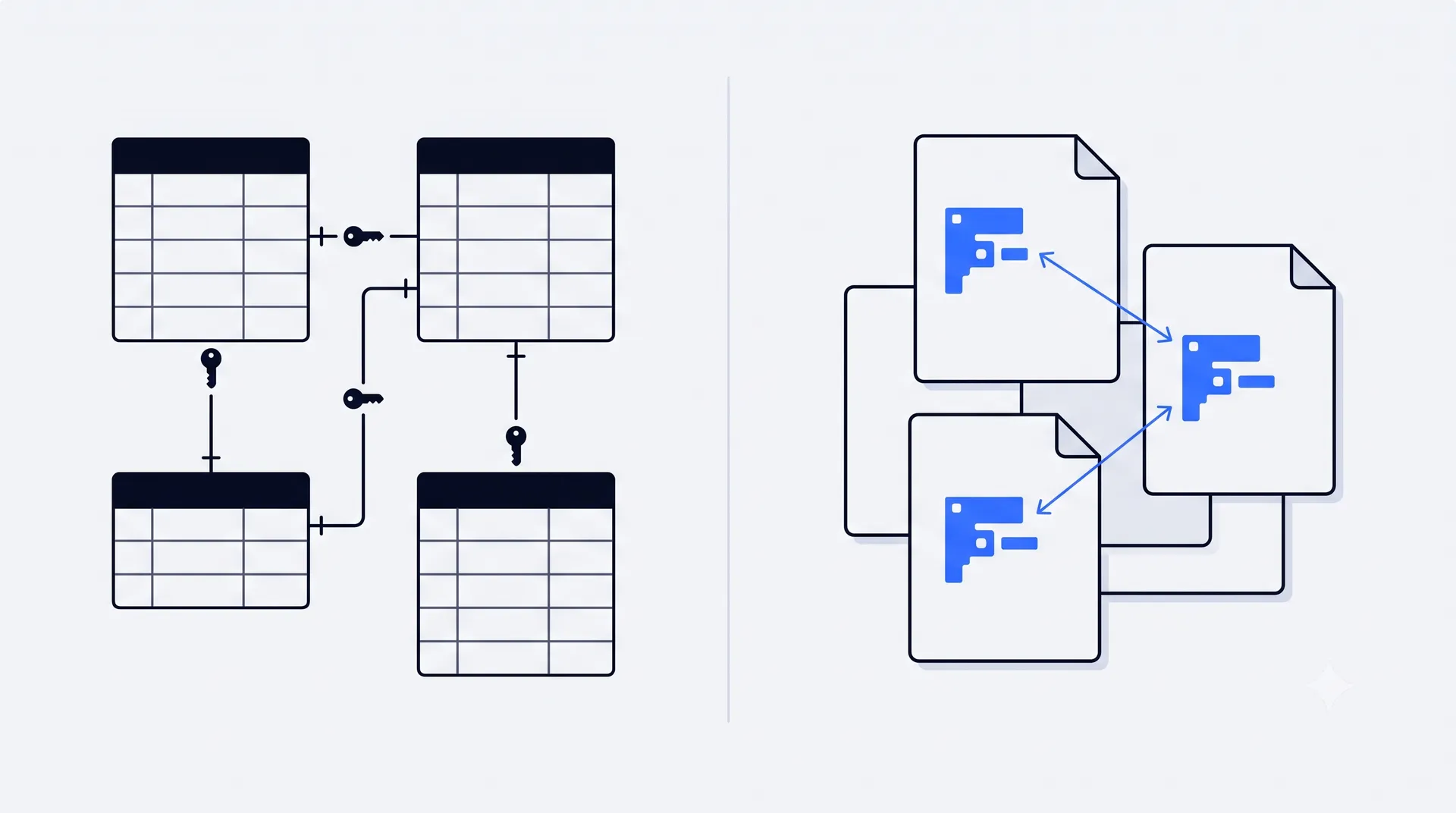
The shape of your data should pick your database, and creator-economy data is relational to its core. Creators have content. Content has categories. Users have subscriptions. Subscriptions map to tiers, tiers to payouts, payouts to creators. Every meaningful query in CreatorBit is a question across those relationships: which subscribers of this creator engaged with that content type this month?
In Postgres, that's a join — the thing relational databases have spent forty years getting right, with foreign keys and constraints enforcing integrity so bad states can't be written in the first place. In Firestore, there are no joins. That's not a criticism; it's the design. Firestore is a document store, and the standard patterns are denormalization and duplication: copy the creator's name into every content document so you can render a feed in one read, then update every copy when the name changes.
I sketched CreatorBit's data model both ways during the evaluation, and the Firestore version kept growing little maintenance obligations — duplicated fields to keep in sync, aggregation documents to maintain, queries restructured to fit what the document model could answer. Each one is manageable. Collectively, they're a schema's worth of integrity rules reimplemented by hand in application code, by the person who is also the frontend developer, the DevOps team, and customer support. Postgres enforces those rules for free, in the database, where they can't be forgotten.
The honest caveat: if your data genuinely is document-shaped — user profiles, content blobs, configuration, things that live and die as self-contained units — Firestore's schemaless flexibility is an asset, not a compromise. Mine isn't. Most SaaS data isn't. But "Postgres because relational" only wins when your data is actually relational, and it's worth checking rather than assuming.
There's also a forward-looking piece that mattered more than I expected: AI features. Postgres has pgvector, which means embeddings for search and recommendation features live in the same database as everything else — one query can join vector similarity against ordinary relational filters. For the AI features I'm building into CreatorBit on the Claude API, that's one integrated system instead of a separate vector service stitched to the backend. Firebase can absolutely do AI — Google has been integrating Gemini tooling deeply — but the architecture tends toward composing multiple Google Cloud services rather than one database that does both jobs.
Row-Level Security: Harder to Learn, Better to Own
Supabase's auth model cost me more upfront effort than Firebase's would have, and I'd still choose it again. The two platforms secure data in fundamentally different ways. Firebase gives you Security Rules: a declarative language, quick to set up, well-documented, and fine for straightforward cases. Supabase gives you Postgres Row-Level Security — you write actual SQL policies that filter which rows each authenticated user can see and touch, enforced by the database itself.
RLS has a real learning curve, and I'll be specific about the friction rather than pretend there wasn't any. Policies fail silently by design: a wrong policy doesn't throw an error, it just returns fewer rows than you expected, and the first few times that happens you'll debug your application code for an hour before suspecting the database. Writing policies that are both correct and fast takes practice. This is the least pleasant part of the Supabase learning curve and nobody should tell you otherwise.
But here's why I consider that cost worth paying: RLS puts authorization at the data layer, which means it applies to every path into the database — the API, the dashboard, a future admin tool, a script I write at midnight. There's no route to the data that bypasses the policy. For a platform holding creators' earnings data and subscriber relationships, "the database itself refuses to show user A user B's rows" is a stronger guarantee than "every access path remembered to check." And because policies are SQL, the security model is inspectable in one place instead of scattered across rule files and application middleware.
Firebase's auth product is more polished out of the box, especially for mobile sign-in flows. If my security needs were simple, its rules would have been faster to ship. Mine aren't, and complexity that exists in the product has to live somewhere — I'd rather it live in the database, versioned and testable, than in my application code's discipline.
Open Source Only Counts If the Open Part Is the Part You Depend On
Supabase's open source mattered to me for one precise reason: the core I depend on — Postgres — is fully self-hostable, and I can leave at any time with a pg_dump. That's not ideology. That's an exit, measured in hours.
I've become much more careful about this distinction since watching Google shut down Gemini CLI for individual users with no grace period. The lesson from that shutdown was that "open source" as a label protects you exactly as far as the open part is the part you actually depend on — an open client on a proprietary backend is a convenience that can be revoked. Applied here, the two platforms sit on opposite sides of that line. Firebase is closed-source and Google-hosted; your data model, security rules, and service integrations are expressed in Firebase's terms, and migrating off Firestore isn't an export, it's a re-architecture into a different database paradigm. Supabase's entire pitch runs the other way: the database is standard Postgres, the dialect is standard SQL, and if Supabase-the-company vanished or tripled its prices, my schema, my data, and even my RLS policies move to any Postgres host essentially intact.
Will I ever actually self-host? Probably not — the managed platform is the product I'm paying for, and I argued in the solo-tools post that paying for someone else's on-call rotation under your data is the most leveraged subscription a solo developer buys. But exit cost and exit use are different things. A cheap exit changes the relationship even if you never take it: it caps your downside on every future pricing change, acquisition, or strategy pivot. Firebase asks for trust in Google's roadmap. Supabase asks for trust in Postgres. One of those has a forty-year track record and no shareholders.
Pricing You Can Predict Beats Pricing You Can Optimize
Supabase charges primarily for what you store; Firebase charges for what you do — and for a solo founder, the first model is worth a real premium. Firestore bills per operation: reads, writes, and deletes are metered, which means your bill is a function of your users' behavior and your code's query patterns. Ship an inefficient component that re-reads a collection on every render and you find out at the end of the month. The free tier is generous in daily operation counts, but the cost curve beyond it requires you to become a part-time billing analyst, optimizing read patterns as a cost-control discipline.
Supabase's model is a flat monthly tier based mostly on storage and included capacity, with API requests effectively unmetered. I can hold my worst-case bill in my head. As someone who has also written on this blog about runway math for indie hackers, I'll take a slightly higher predictable number over a lower surprising one every time — variance is its own cost when the budget is personal savings, and a pricing model that punishes traffic spikes is a strange thing to attach to a product you hope will spike.
Supabase vs Firebase at a Glance
Here's the comparison compressed, weighted by nothing — the weighting is the whole rest of this post:
| Dimension | Supabase | Firebase |
|---|---|---|
| Database | PostgreSQL (relational, SQL, joins, constraints) | Firestore (NoSQL documents, no joins, schemaless) |
| Source model | Open source, self-hostable core | Closed source, Google-hosted |
| Authorization | Postgres Row-Level Security (SQL policies) | Security Rules (declarative, faster to start) |
| Pricing basis | Storage-based tiers, unmetered API requests | Per-operation (reads/writes/deletes metered) |
| Mobile SDKs | Improving, younger | Mature, excellent (Flutter especially) |
| Real-time | Production-ready for most cases | Best-in-class, core to the platform |
| AI/vector search | pgvector in the same database | Composed from multiple Google Cloud services |
| Exit cost | pg_dump to any Postgres host | Re-architecture out of the document model |
| Ecosystem extras | Postgres extensions (50+) | Crashlytics, Remote Config, Analytics, A/B testing |
What Firebase Does Better — and When I'd Choose It
An honest comparison has to include the cases where the other choice wins, and Firebase wins several. Mobile-first development is the clearest: Firebase's iOS, Android, and Flutter SDKs are mature in a way Supabase's mobile story still isn't, and the surrounding suite — Crashlytics, push notifications, Remote Config, A/B testing — has no equivalent bundled into Supabase. If CreatorBit were a native mobile app first, this post would probably have the opposite title.
Real-time synchronization is the second. Supabase's real-time features have improved substantially and are production-ready for most cases, but real-time is Firebase's founding DNA — for chat apps, collaborative editors, and live multiplayer state, its infrastructure is the more battle-tested default. And for raw speed-to-prototype — a hackathon, a weekend MVP where the data model is unknown and churning — Firestore's schemaless model genuinely removes friction that Postgres migrations add.
I'd also flag that Google narrowed the biggest gap: Firebase Data Connect, launched in 2024, is a managed PostgreSQL offering with a GraphQL-style query layer — Firebase's first SQL product and a direct answer to the "no relational option" criticism. If I were choosing today with a strong commitment to the Google ecosystem, Data Connect would earn a serious look. It didn't change my answer, because it addresses the data-model criterion while leaving the other two untouched: it's still closed, still Google-hosted, and still priced on Google's terms. Two of my three reasons survive it fully.
Would I Make the Same Choice Again?
Yes — and I've now had enough production time with Supabase to say that with evidence rather than hope. The relational bet paid off exactly as expected: features that would have meant denormalization gymnastics in Firestore are ordinary SQL. The RLS learning curve was real, front-loaded, and finished — the policies I fought with early on now protect every new feature by default. Auth had its own decision tree, which I've written about separately, and the pricing model has done the one thing I hired it to do: stay boring.
The framing I'd hand to anyone making this choice: don't ask which platform is better, ask which platform's failure modes you can live with. Firebase's failure modes are surprise bills, data-model contortions as relationships grow, and deep lock-in to one vendor's roadmap. Supabase's are early friction with RLS, a younger mobile story, and betting on a smaller company — hedged by the fact that the core is Postgres and leaves when you do. For a relational, web-first, solo-built SaaS, the second list is simply cheaper to carry. If your product looks different, your answer legitimately might too — and that's the test of whether a comparison was honest.
For more decisions like this one, working through the actual trade-offs on real projects, see more Tech & Developer Life posts.
FAQ
Frequently asked questions
Is Supabase better than Firebase?
Neither is universally better — they're built on different philosophies. Supabase is the stronger choice for web applications with relational data, teams that want SQL, predictable storage-based pricing, and low vendor lock-in thanks to its open-source Postgres core. Firebase is stronger for mobile-first apps, real-time-heavy products like chat and collaboration tools, and rapid prototyping, backed by mature SDKs and a broad suite of integrated services like Crashlytics and push notifications.
Can Supabase replace Firebase?
For most web applications, yes. Supabase covers the core Firebase use cases — database, authentication, file storage, serverless functions, and real-time — and for relational data it's often a better fit rather than just an equivalent. The main gaps are mobile SDK maturity and Firebase-specific services like Crashlytics, Remote Config, and integrated analytics, which Supabase doesn't replicate. Migrating an existing Firestore app also requires redesigning the data model, not just moving data.
Why do developers choose Supabase over Firebase?
The most common reasons are the PostgreSQL foundation (full SQL with joins, constraints, and 50+ extensions including pgvector for AI features), predictable pricing based on storage rather than metered read/write operations, and the open-source, self-hostable core that lets you export your entire database to any Postgres host. Row-Level Security is a further draw for products with complex authorization needs, since access control is enforced by the database itself rather than application code.
Does Firebase support SQL now?
Yes, partially. Firebase Data Connect, introduced in 2024, is Firebase's first SQL offering — a managed PostgreSQL backend with a GraphQL-style query layer. It addresses the long-standing criticism that Firebase forced a NoSQL document model on relational data. However, it remains closed-source and Google-hosted, so the trade-offs around vendor lock-in and pricing control still differ from an open platform like Supabase.
Written by Jenarius Ganlary
Full-stack developer and MIS & Data Analyst, building CreatorBit and freelancing through Ganlary Labs. Writing about SaaS, AI, and startups as it happens.
More about me →KEEP READING