How Much Do Indie Hackers Actually Make in 2026?
· 6 min read
Most indie hackers make close to nothing. Not "a modest side income" — nothing. The public data on this is more consistent than the Twitter timeline would suggest, and it's worth sitting with the actual numbers before you quit anything or reorganize your life around a dream that mostly doesn't pay.
I say this as someone still building. I run a SaaS product on nights and weekends while working a full-time data analyst role, and I take on freelance client work on the side. I haven't hit a headline number. Most people building solo haven't. That's not a confession, it's the median outcome, and nobody writes threads about the median outcome.
Why the indie hacker income data always looks the same
Every serious analysis of indie hacker revenue — Indie Hackers' own Stripe-verified data, third-party scrapes of public "milestones" pages, community surveys — lands on the same shape: a tiny number of products doing very well, a slightly larger group doing okay, and a long, flat tail of products making single digits or nothing at all.
One widely cited analysis of verified-revenue products found the median monthly revenue across all listed products was around $30. Not $30,000. Thirty dollars. Only about 5% of analyzed products cleared roughly $8,000/month — a number that's genuinely not hard to hit as a salaried software engineer with a full-time job and zero founder risk.
That gap between "not hard to earn employed" and "the ceiling most solo products never reach" is the whole story of indie hacking, and it rarely makes it into the posts that go viral.
The rough distribution, if you're building right now
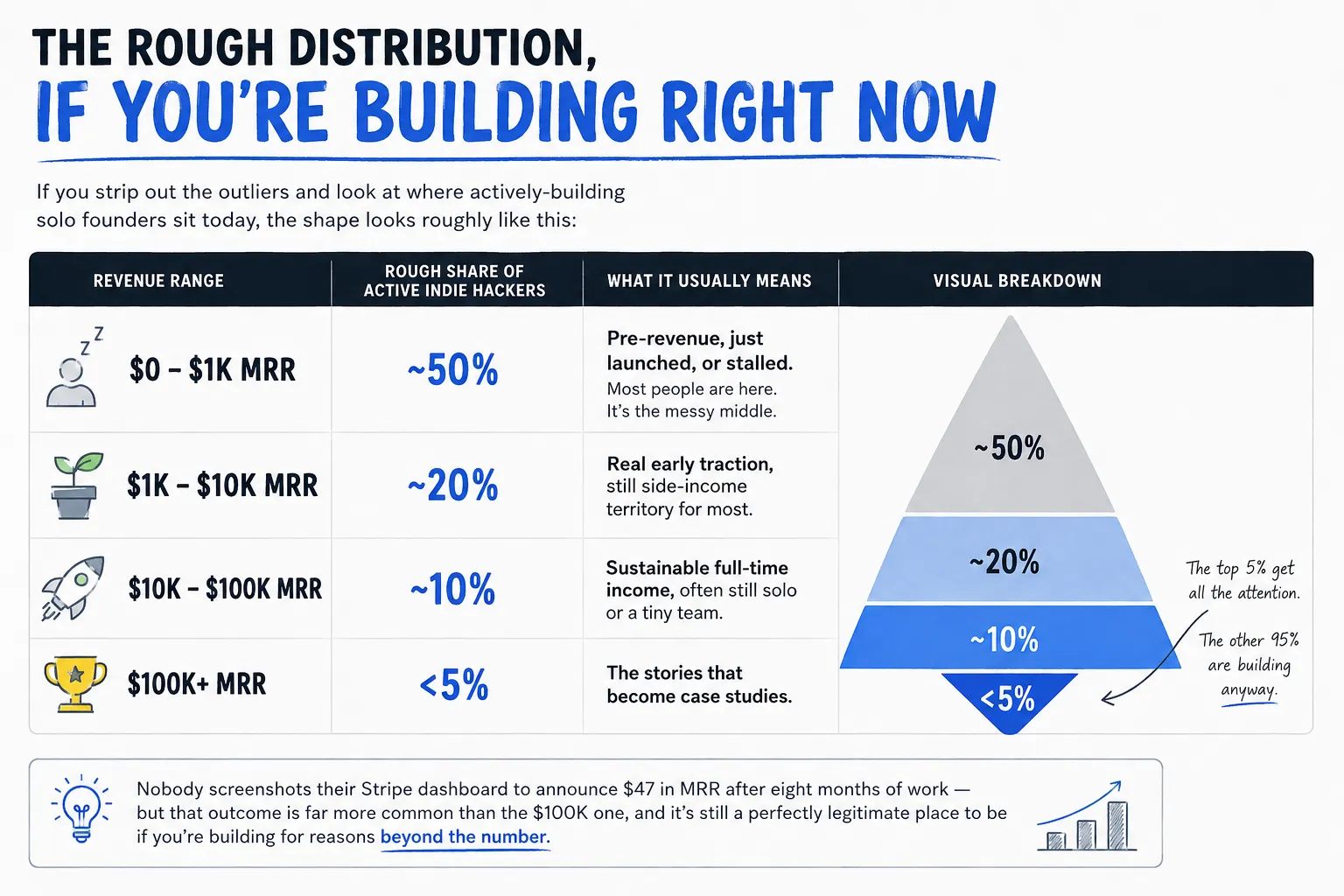
If you strip out the outliers and look at where actively-building solo founders sit today, the shape looks roughly like this:
| Revenue range | Rough share of active indie hackers | What it usually means |
|---|---|---|
| $0–$1K MRR | ~50% | Pre-revenue, just launched, or stalled |
| $1K–$10K MRR | ~20% | Real early traction, still side-income territory for most |
| $10K–$100K MRR | ~10% | Sustainable full-time income, often still solo or a tiny team |
| $100K+ MRR | Under 5% | The stories that become case studies |
If you've seen a solo founder's Twitter thread this year, it almost certainly came from that bottom 5%. Nobody screenshots their Stripe dashboard to announce $47 in MRR after eight months of work — but that outcome is far more common than the $100K one, and it's still a perfectly legitimate place to be if you're building for reasons beyond the number.
Survivorship bias isn't a minor caveat, it's the entire mechanism
The reason indie hacking looks more winnable than it is comes down to a simple selection effect: people who fail, stall, or quietly abandon a product don't write a retrospective. People who hit $50K MRR write a very detailed one, complete with a revenue chart and a "here's exactly what I did" breakdown.
There's a second, quieter version of this bias too — people who succeed enough to stop needing a community for motivation also stop posting there. So even inside indie hacker forums, the visible population skews toward either total beginners or people who haven't cracked it yet, with the actual winners mostly gone quiet and busy running their now-real business.
Put those two effects together and you get a feed that structurally cannot show you the median experience, only the two tails.
What the realistic timeline actually looks like
The other thing the highlight reel skips is time. Going from $0 to $10K MRR is commonly reported to take somewhere in the range of one to three years for products that get there at all — not the "shipped in a weekend, $10K MRR in 47 days" framing that circulates. Getting from $10K to $100K MRR typically takes another one to three years on top of that.
This matches what I've seen in my own timeline running a SaaS product alongside a day job. Progress compounds slowly and unevenly. Some months you ship a feature and nothing moves. Some months a small distribution change (a better landing page headline, a Show HN post that lands, one useful integration) moves more than three months of feature work did. There's no clean formula for which month that will be, which is exactly why the "I did X and hit Y" narrative is so seductive — it retroactively assigns a clean cause to what was often a slow accumulation plus one lucky break.
Where the "day job" changes the math
Most solo founder content assumes you've already gone all-in. The math looks completely different if you haven't, and I'd argue that's the more common starting point, not the exception.
Working full-time while building removes the survival pressure that forces premature monetization decisions, but it also caps your iteration speed hard. You get maybe an hour or two on a weeknight and a real block on weekends, and that constraint changes what you choose to build — smaller scope, fewer moving parts, less tolerance for rebuilding things that don't need rebuilding yet.
I've written in more detail about what that tradeoff actually costs day to day in Building a SaaS Solo While Working a Full-Time Job, and the runway math changes too if you're not yet dependent on the product's revenue — I break that down in The Indie Hacker's Guide to Runway Math.
What I'd actually tell someone starting today
Not "don't do it." The data doesn't say that. It says: know which distribution you're actually in before you make life decisions based on someone else's outlier outcome.
A few things I'd hold onto:
- Treat the first 12–18 months as the median case, not the exception. If you're at $0–$1K MRR after a year of consistent work, you're exactly where the data says most people are, not failing some benchmark the successful people hit.
- Separate "worth continuing" from "hit some revenue number." A product with real users and slow growth is a different situation than one with no users at all, even if both currently show $200 MRR.
- Don't let a public "I quit my job for this" narrative pressure you into leaving stable income before the product's growth curve, not your bank account's patience, tells you it's time.
- If you're going to look at anyone's numbers, look for the ones who show the flat months too, not just the launch and the milestone post.
The realistic version of indie hacking is slower, quieter, and far more ordinary than the version that goes viral. That's not a discouraging thing to know — it's the information you actually need to make a good decision about your own time.
For more on the decisions that come after you've got something worth continuing, see more Startups & Indie Hacking posts.
FAQ
Frequently asked questions
How much money does the average indie hacker make?
Public Stripe-verified revenue data on indie hacker products consistently shows a median monthly revenue in the tens of dollars, not thousands — with a small percentage of products (around 5% in the most cited analysis) clearing roughly $8,000/month or more. Most products that get listed publicly make very little or nothing.
Is indie hacking actually profitable?
It can be, but profitability is heavily concentrated in a small percentage of products, similar to startup outcomes generally. The realistic expectation for someone starting today is a slow, multi-year climb rather than a fast path to replacing a salary, and most solo builders should plan around that timeline rather than the outlier stories that get shared publicly.
How long does it take to reach $10K MRR as a solo founder?
Community data and case studies commonly put the $0-to-$10K-MRR journey at somewhere between one and three years for products that reach it at all, not the compressed weeks-long timelines highlighted in viral launch stories. Getting from $10K to $100K MRR typically takes a similar or longer additional stretch.
Should I quit my job to build a SaaS product full-time?
That depends on your specific financial runway and the traction your product already has, not on what worked for someone else's public story. Most indie hackers who eventually go full-time do so after their product already shows meaningful, sustained revenue — not before, and not as the move that creates the traction.
Written by Jenarius Ganlary
Full-stack developer and MIS & Data Analyst, building CreatorBit and freelancing through Ganlary Labs. Writing about SaaS, AI, and startups as it happens.
More about me →KEEP READING