Why JioPC Works But Cloud Gaming in India Doesn't (Yet)
· 9 min read
On September 2, 2026, Reliance Jio opened JioPC — its cloud-based virtual desktop — to anyone in India with an internet connection, dropping the old requirement that you had to be a JioFiber broadband subscriber to use it. Within two days, half a dozen tech outlets had published some version of the same article: what JioPC is, what it costs, how to sign up. What none of them asked is the question that actually matters if you build software for a living: why can Jio rent out a full desktop's worth of compute for a couple hundred rupees a month, while cloud gaming — a problem that looks superficially identical — is still an unsolved, half-launched category in this country?
That gap is the interesting story here. Not "Jio launched a product." The fact that one form of cloud compute rental in India is mature and cheap, and an adjacent one is still stuck in early access and monthly hour caps, tells you something real about where the actual bottleneck sits — and where the opportunity still is.
What Actually Launched
The change is distribution, not the product: JioPC is now sold as a standalone subscription to anyone in India with a working internet connection and a mobile number — no Jio broadband, no set-top box, no existing Jio relationship required.
JioPC itself isn't new — it first shipped in July 2025 as a TV-based service, accessed through the Jio set-top box already sitting in JioFiber homes. The pitch then was straightforward: most Indian households own a TV, far fewer own a PC, so let the TV become a PC by streaming one from the cloud.
The service itself is a straightforward compute-as-a-service play. Two tiers, both running Ubuntu Linux:
- Standard — 4 virtual CPUs, 8GB RAM, 500GB cloud storage
- Ultra — 8 virtual CPUs, 16GB RAM, 1TB cloud storage
Pricing runs roughly ₹1,000 for two months on the entry tier, scaling up to about ₹4,000 for fourteen months on longer commitments. The framing Jio is using is "AI-ready" — the idea that a laptop bought eight years ago can suddenly run modern AI tooling because the actual computing happens in a Reliance data center, not on the device in front of you.
That's a real, well-aimed bet. India has tens of millions of PCs in active use, and replacement cycles for consumers and small businesses stretch five to six years. If you can't afford to replace the hardware, and the hardware can't run what you need it to run, renting the missing compute is a genuinely rational alternative — one Jio is uniquely positioned to sell at this price because it already owns the fiber and the data centers.
Why the Same Model Hasn't Worked for Gaming
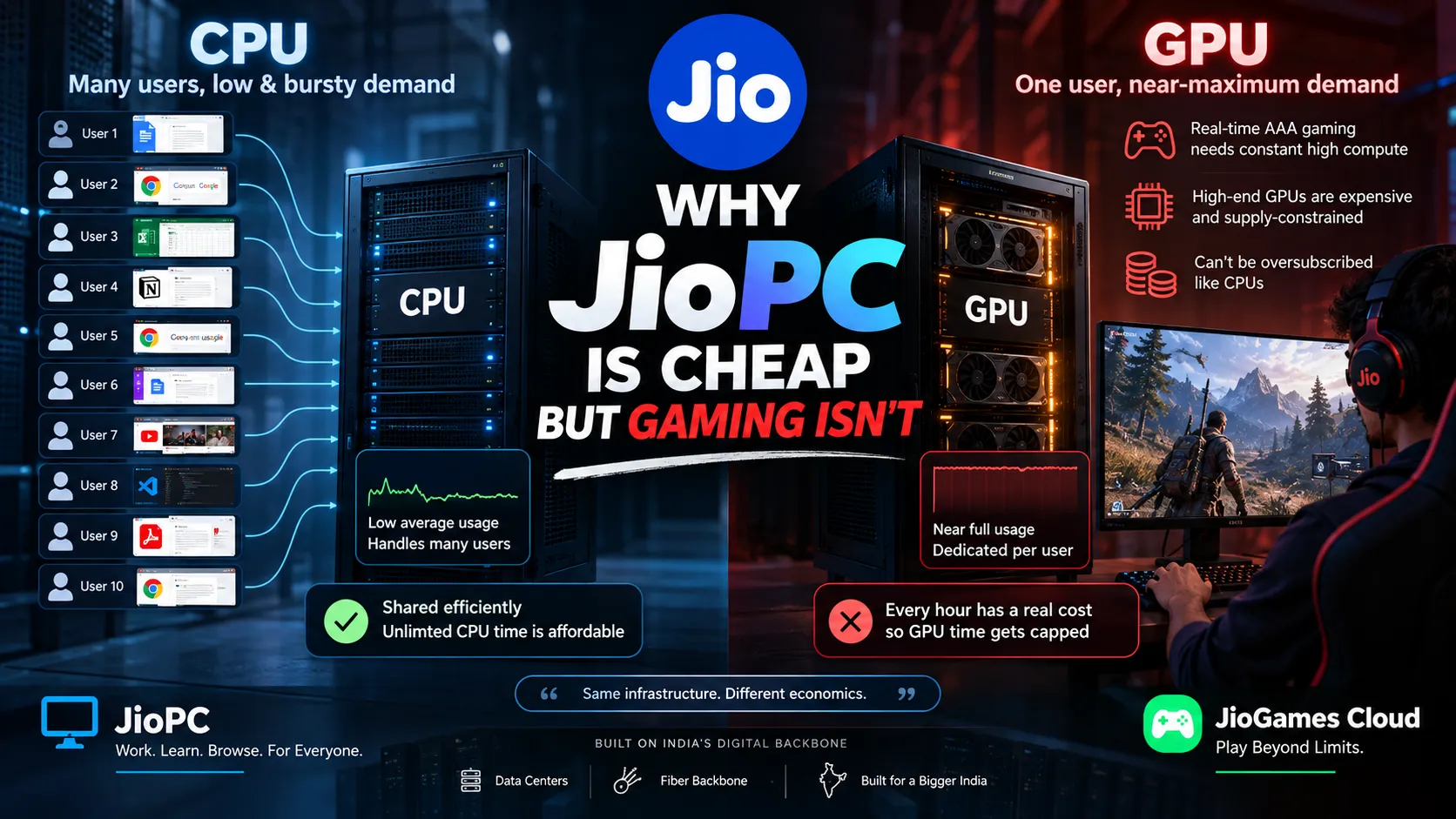
CPU cloud compute for productivity workloads is cheap to oversubscribe. GPU cloud compute for real-time gaming is not. That single difference is why JioPC and cloud gaming, despite both selling "compute from the cloud," end up priced in completely different shapes.
You can see it in the market today. JioGames Cloud has existed since before this JioPC relaunch, purpose-built with Indian servers for lower latency. Xbox Cloud Gaming is available through Game Pass Ultimate. Nvidia's GeForce Now, backed by GPU hardware in the cloud, is expanding into the Indian market with paid tiers that come with a monthly hour cap on play time, not unlimited access.
That last detail is the tell. JioPC doesn't ration your CPU hours — you pay a flat monthly-equivalent fee and use the desktop as much as you want. GeForce Now's Indian tiers cap you at a fixed number of hours per month even on paid plans. Two products that both claim to "stream compute from the cloud" are pricing themselves in fundamentally different ways, and that difference isn't a marketing choice — it's a cost structure being passed straight through to the customer.
| JioPC (CPU cloud desktop) | GPU cloud gaming (GeForce Now, JioGames Cloud) | |
|---|---|---|
| Workload | Office apps, browsing, light AI tooling | Real-time 3D rendering at 60fps |
| Latency tolerance | Seconds are fine | Under ~40ms round-trip or gameplay feels broken |
| Resource sharing | Many idle users can share one physical server | One GPU is largely tied to one active session |
| Hardware cost | Commodity CPUs, cheap and abundant | High-end GPUs, expensive and supply-constrained |
| Pricing model seen in market | Flat, unlimited-time subscription | Hour-capped tiers even on paid plans |
A CPU server handling ten people's document editing and browser tabs is barely breaking a sweat most of the time — those users' actual simultaneous compute demand is low and bursty, so Jio can stack many customers on the same hardware and the economics work at ₹1,000 for two months. A GPU rendering a AAA game in real time for one person is running near its ceiling for the entire session. You can't meaningfully oversubscribe it the same way. Add in that high-end GPUs are still supply-constrained and expensive relative to CPUs, and you get exactly the pricing behavior we're seeing: unlimited CPU time is affordable to give away, GPU time gets capped because every hour has a real, non-trivial marginal cost.
There's also a build-cost signal hiding in plain sight here. Reliance is arguably the single best-positioned company in India to solve this — it already owns the data centers, the fiber backbone, and a gaming-specific cloud product in JioGames Cloud. And it has kept JioGames Cloud and JioPC as two separate products rather than merging GPU access into the same subscription. If solving GPU-backed cloud compute at CPU-like pricing were straightforward, the company with the most infrastructure to do it cheaply would have done it already. It hasn't, and that's more informative than anything in the JioPC launch coverage itself.
Who Each Product Actually Serves, and Where Each One Breaks
The economics explain the pricing gap, but they also explain who these products are actually good for — and where each one falls apart in practice.
JioPC — good fit for:
- Households or small businesses running an aging laptop that can no longer handle a modern browser with fifteen tabs open, or basic AI tooling
- Students who need a real desktop environment but can't justify buying new hardware
- Light, forgiving workloads — office apps, browsing, coding in a text editor, casual use of AI assistants
JioPC — where it breaks down:
- Anything latency-sensitive in the other direction — heavy local video editing, large local builds, or workloads that assume low round-trip time to your own files, since everything now depends on your internet connection staying up
- Serious AI/ML work — 8 vCPUs and 16GB RAM is a productivity ceiling, not a training rig
Cloud gaming (GeForce Now, JioGames Cloud, Xbox Cloud Gaming) — good fit for:
- Casual and story-driven single-player games, where a frame or two of input lag doesn't change the outcome
- Players who already have stable, reasonably fast broadband and just don't own gaming-grade hardware
- JioGames Cloud specifically benefits from Jio's own Indian server placement, so latency is more forgiving there than on services still ramping up India-specific data center capacity
Cloud gaming — where it breaks down:
- Competitive, twitch-reflex genres — fighting games, competitive shooters, rhythm games — where even 40-60ms of added round-trip lag is the difference between landing a hit and missing it. This isn't a bug that gets patched out; it's physics. Your input has to travel to a data center, get processed, and the video has to travel back, and that round trip has a floor set by distance and network quality
- Anyone on inconsistent home broadband or shared mobile data, where jitter — not just average latency — causes visible stutter mid-session
- Budget-conscious heavy players, given the hour-capped paid tiers mentioned earlier — this isn't a "play as much as you want" product the way JioPC is for compute
The honest read: JioPC's lag tolerance is generous because almost nothing you do on a productivity desktop needs a response in under a few hundred milliseconds. Cloud gaming's lag tolerance is brutal because competitive play needs a response in under a few dozen. That's the same underlying constraint as the cost table above, just showing up as a user experience problem instead of a pricing problem — which is exactly why solving the economics doesn't automatically solve the product.
So What This Means If You're Sizing This Opportunity
I think about market gaps like this the way I'd think about picking what to build next — the news is the signal, not the plan. JioPC just did the hard part of proving Indian consumers will pay monthly for rented compute instead of buying hardware. That's genuinely useful validation, and it's exactly the kind of demand signal that's easy to over-read. It's worth being honest about what it does and doesn't prove:
What it proves: Indian consumers and small businesses will subscribe to compute-as-a-service when it's priced right and solves a real hardware-age problem. The willingness-to-pay for "rent instead of replace" is established.
What it doesn't prove: That the same unit economics carry over to GPU workloads. They don't, for the reasons above. Anyone reading "JioPC's cheap and popular, so a cheap GPU cloud gaming service should also work" is skipping the actual hard problem — which is regional GPU capacity, not consumer willingness to pay.
If you're a technical founder actually looking at this space, the real question isn't "is there demand for cloud gaming in India" — the coverage above already shows there is, and several companies are chasing it. The question is whether you can get GPU-hours cheap enough, close enough to your users (latency again), to price the way JioPC prices CPU-hours. That's an infrastructure and capital problem before it's a product problem, and it's worth sizing honestly before writing a line of code — the kind of homework market research reports alone won't do for you. Reading ten analyst reports about India's cloud gaming TAM won't tell you what a GPU-hour actually costs you at the latency your users need; only pricing it against a real provider will.
It's also worth running the numbers the boring way before getting attached to the idea. GPU instances aren't priced like CPU instances anywhere in the world, and if your runway math assumes GPU compute costs behave like the CPU compute costs you're used to from a typical SaaS stack, you'll find out you were wrong at the worst possible time — after you've already committed spend. That's the same lesson from runway math for any bootstrapped, infrastructure-heavy idea: the assumption that breaks your model is usually a line item you didn't think hard enough about, and for a compute-rental business, that line item is almost always the compute itself.
None of this means the gap isn't real or worth pursuing. Jio validating that Indians will rent compute is a genuinely useful data point. It just isn't the same data point as "Indians will rent GPU compute at CPU-compute prices" — and conflating the two is the mistake I'd want to avoid making if I were sizing this seriously.
FAQ
Frequently asked questions
Is JioPC the same thing as cloud gaming?
No. JioPC is a CPU-based virtual desktop for productivity and light AI tooling, running on Ubuntu Linux with up to 8 virtual CPUs and 16GB of RAM. Cloud gaming services like GeForce Now or JioGames Cloud stream real-time 3D rendering from dedicated GPUs, which is a fundamentally different and more expensive workload to deliver.
Why can't Jio just add GPU access to JioPC?
It could, technically, but GPU-backed cloud sessions cost significantly more per active user than shared CPU compute because GPUs can't be oversubscribed across idle users the way CPUs can, and high-end GPU hardware remains supply-constrained. Jio already runs a separate gaming-focused cloud product rather than merging GPU access into JioPC's pricing, which suggests the economics don't yet support offering both at the same flat rate.
Does JioPC's launch mean cloud gaming in India is close to being solved?
Not directly. JioPC proves Indian consumers will pay a monthly subscription to rent compute instead of buying hardware, which is useful demand validation. It doesn't prove GPU-hours can be delivered at the same low, unlimited-access price point, since the underlying cost structure of GPU compute is fundamentally different from CPU compute.
What should a founder actually check before building in this space?
Get real quotes on GPU-hour pricing from cloud providers with data center presence close to your target users, and model latency requirements before writing a business plan around it. The bottleneck in India-focused cloud gaming has historically been regional GPU capacity and latency, not consumer demand — so validate the supply side first, not the demand side.
Written by Jenarius Ganlary
Full-stack developer and MIS & Data Analyst, building CreatorBit and freelancing through Ganlary Labs. Writing about SaaS, AI, and startups as it happens.
More about me →KEEP READING