Same Founder, Two Failed Games, One Became Slack
· 7 min read
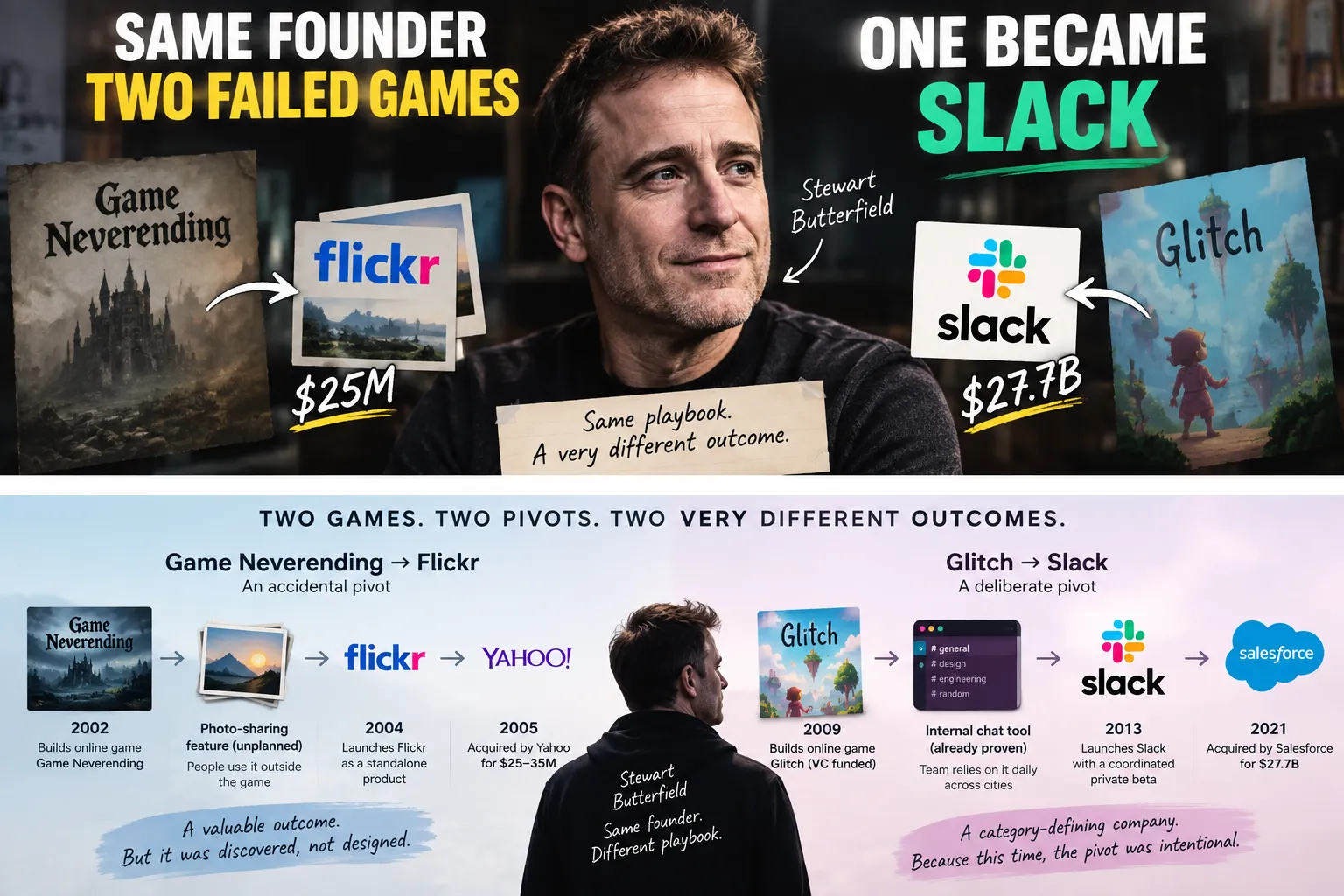
Stewart Butterfield ran the exact same pivot twice — a failed game abandoned, a side tool inside it turned into the real product — and the two outcomes differed by roughly a thousand times, because the second time he changed what he pivoted toward and how he launched it, not because he simply got lucky twice.
In 2002, he co-founded a company to build an online game called Game Neverending. It never found an audience. Buried inside it was a photo-sharing feature the team had built almost as an afterthought. That feature became Flickr, sold to Yahoo in 2005 for somewhere between $25 and $35 million depending on the source.
In 2009, he did it again. This time the game was called Glitch — a whimsical, non-violent, cooperative online world funded by Andreessen Horowitz and other serious investors. It also failed to find an audience, and Butterfield shut it down in December 2012. Buried inside that company, again, was an internal tool the team had built for themselves: a searchable, always-on chat system they used to coordinate work across cities. That tool became Slack. Salesforce acquired it in 2021 for $27.7 billion.
Most retellings of this story stop at "he knew when to walk away" and treat it as a lesson about founder instinct. That undersells it. Butterfield had already lived through this exact pivot once before he built Glitch — he wasn't discovering a pattern, he was repeating one on purpose. Which makes the actual interesting question not "why did he pivot," but "what did he do differently the second time, knowing what he already knew?"
The First Pivot Was an Accident He Happened to Notice
Game Neverending was a browser-based multiplayer game that Butterfield's company, Ludicorp, built starting in 2002. It struggled to find players. Somewhere in its feature set was a photo-sharing tool — a way for players to upload and share images inside the game's world. As the game itself failed to gain traction, the team noticed people were using the photo-sharing feature in ways that had nothing to do with the game at all.
There's an important detail in how this pivot happened: nobody set out looking for it. The feature existed to serve the game. Its usefulness outside the game was discovered, not designed. Ludicorp shipped Flickr as a standalone product in 2004, and Yahoo acquired the company the following year.
This is a real, valuable outcome — a $25–35 million exit is not a failure by almost any reasonable measure. But it's worth being precise about what kind of pivot this was: an incidental feature, discovered late, sold to a single acquirer within about a year of realizing what they had.
The Second Pivot Was Deliberate, and the Tool Was Already Proven
Glitch was a much bigger swing than Game Neverending. Tiny Speck, the company Butterfield founded in 2009 with several former Flickr colleagues (including Cal Henderson, who'd go on to become Slack's CTO), raised real venture capital and spent three years building an ambitious, artistically distinct MMO. It never found the scale it needed. In December 2012, Butterfield told his team they had to shut the game down.
But the internal chat tool Tiny Speck had built to coordinate its own distributed team wasn't a side feature nobody had paid attention to. It was software the team had depended on daily, under real production pressure, for years. It was searchable, worked across devices, and had already replaced things like IRC and email for the people building Glitch. When the game died, the team wasn't discovering a hidden gem — they were looking at a tool whose value they already understood intimately, because they'd been the ones relying on it.
That distinction matters more than it sounds like it should. A feature nobody was watching closely (Flickr) and a tool your own team can't function without (the thing that became Slack) are different categories of validation. One tells you strangers might like something. The other tells you a specific, painful problem — team communication under real deadline pressure — was already being solved well enough that walking back to email felt unthinkable.
The Distribution Move Flickr Never Had
The other difference is less about the product and more about how it reached people. Slack's team ran a coordinated private beta in mid-2013, inviting a handful of real companies to start using the tool simultaneously and report back before any public launch. When they opened it up more broadly in August 2013, roughly 8,000 companies signed up within 24 hours — driven by a freemium model where teams could start free and only pay once usage deepened enough to justify it.
Flickr, launching in 2004, didn't have anything like that distribution mechanism available to it. Product-led freemium growth loops weren't a mature playbook yet, and Flickr's growth was closer to organic, gradual adoption inside the early blogging and photo-sharing community. Neither pivot was mishandled — the tools available in 2004 were simply different from the tools available in 2013. But it means comparing the two outcomes purely on "founder instinct" misses that Slack also launched into a moment when viral, bottom-up SaaS adoption was a known, repeatable strategy, and Butterfield's team used it deliberately.
What Actually Changed Between the Two Pivots
| Flickr (2004) | Slack (2013) | |
|---|---|---|
| Origin of the pivoted product | An incidental feature, discovered after the fact | A tool the team already depended on daily |
| Validation before the pivot | None — usefulness noticed only as the game failed | Years of internal, high-stakes daily use |
| Launch mechanism | Gradual, organic adoption | Coordinated private beta, then freemium public launch |
| Outcome | Acquired for $25–35M within about a year | Acquired for $27.7B, eight years after launch |
| What the founder already knew | Nothing — first time through this pattern | Everything — he'd lived this exact pivot once before |
The pattern — failed game, salvage the internal tool, pivot the company — is identical across both. What changed is that the second time, Butterfield had already validated the tool for years before betting on it, and launched it using a distribution mechanism that didn't exist for the first pivot. Repeating a strategy that worked once doesn't guarantee a better result. What actually separates the two outcomes is that the second bet was placed on something with more evidence behind it, launched in a smarter way — not that lightning struck twice.
Why "Know When to Quit" Undersells the Real Lesson
The generic version of this story treats Butterfield's willingness to abandon Glitch as the key insight — the founder wisdom to recognize a dead end and walk toward something else instead of grinding it out. That's true, but it's not the differentiator between his two outcomes, because he did exactly that both times. What's different is what he had ready to walk toward.
The more useful version of the lesson, if you're building something yourself: the internal tools and workarounds you build just to keep your own project functioning are not automatically a backup plan — they only become one if you've actually stress-tested them under real pressure long enough to know they're solving something, and you're honest with yourself about whether you have a way to get that thing in front of people once you decide to bet on it. Butterfield's first pivot worked because he noticed something. His second pivot worked bigger because he'd already proven something, and he knew how to launch it.
If you've read Why I Went Into Debt Building a SaaS Nobody Wanted, the harder version of this same lesson is in there — the cost of not having a validated fallback ready when the thing you're building doesn't land. Butterfield had one, twice. Most founders don't build that safety net on purpose; it's usually an accident when it exists at all.
This is the second entry in an ongoing series documenting company journeys from founding struggle to where they are now — you'll find more like it under Startups & Indie Hacking.
FAQ
Frequently asked questions
Did Stewart Butterfield pivot from a failed game more than once?
Yes. In 2002 he co-founded Ludicorp to build a game called Game Neverending, which failed, and a photo-sharing feature inside it became Flickr, sold to Yahoo in 2005. In 2009 he founded Tiny Speck to build a game called Glitch, which also failed, and an internal chat tool the team had built for itself became Slack, acquired by Salesforce in 2021.
Why did Slack sell for so much more than Flickr?
The two pivots weren't equally validated before they happened. Flickr's photo-sharing feature was discovered almost by accident as Game Neverending was failing, with no real evidence beforehand that it could stand alone. Slack's internal chat tool had already been used daily under real production pressure by Tiny Speck's own team for years before the pivot, and it launched using a coordinated private beta and freemium growth model that didn't exist as a strategy in 2004.
What was Glitch, and why did it fail?
Glitch was a cooperative, non-violent massively multiplayer online game built by Tiny Speck starting in 2009, funded by investors including Andreessen Horowitz. Despite genuine artistic ambition and years of development, it never reached the player base needed to sustain the business, and Stewart Butterfield shut it down in December 2012.
Is Slack's origin story similar to other startup pivots?
The specific mechanism — a game or consumer product fails while an internal tool built to support it turns out to be the more valuable asset — is Butterfield's own repeated pattern rather than a common industry template, since he used it twice with the same underlying company. The broader idea of pivoting toward a tool built to solve your own problem is a recognizable pattern in software more generally, but the scale of Slack's outcome is unusual even among pivot stories.
Written by Jenarius Ganlary
Full-stack developer and MIS & Data Analyst, building CreatorBit and freelancing through Ganlary Labs. Writing about SaaS, AI, and startups as it happens.
More about me →KEEP READING