Why I Went Into Debt Building a SaaS Nobody Wanted
· 6 min read
I used to believe that a million-dollar SaaS idea was a golden ticket. Pick the right niche, build the product, automate everything, and the money shows up while you sleep. That fantasy is everywhere — threads telling you which idea to clone, which micro-SaaS to chase, which stack guarantees passive income. I fell for it hard enough to go into debt over it.
This isn't a framework post. I've already written about how I decide what to build next and about skipping market research on a feature nobody asked for. This one is smaller in scope but heavier: what it actually costs, financially and personally, when you skip validation on the whole project instead of just one feature.
The Idea Felt Too Good to Skip Validating
I poured months into a product I was certain people needed, without validating any of it. No landing page test, no cold outreach, no conversation with a single person who might have used it. I just built. The idea felt obvious enough that asking first seemed like a waste of time I could spend shipping instead.
That's the trap. When an idea feels self-evidently good, validation feels like friction between you and the launch, not information you actually need. I skipped it because I was excited, not because I had any evidence I didn't need it.
What Skipping Validation Actually Cost Me
I spent money I didn't have. I hired help I couldn't afford, because a growing to-do list felt like proof the project was real and moving. I told myself I was one launch away from success — that the spending was an investment, not a hole.
It wasn't an investment. It was debt against a product nobody had asked for. The UI was clean. The features were clever. None of it mattered, because I'd built for a market that didn't exist yet — I'd only assumed it did.
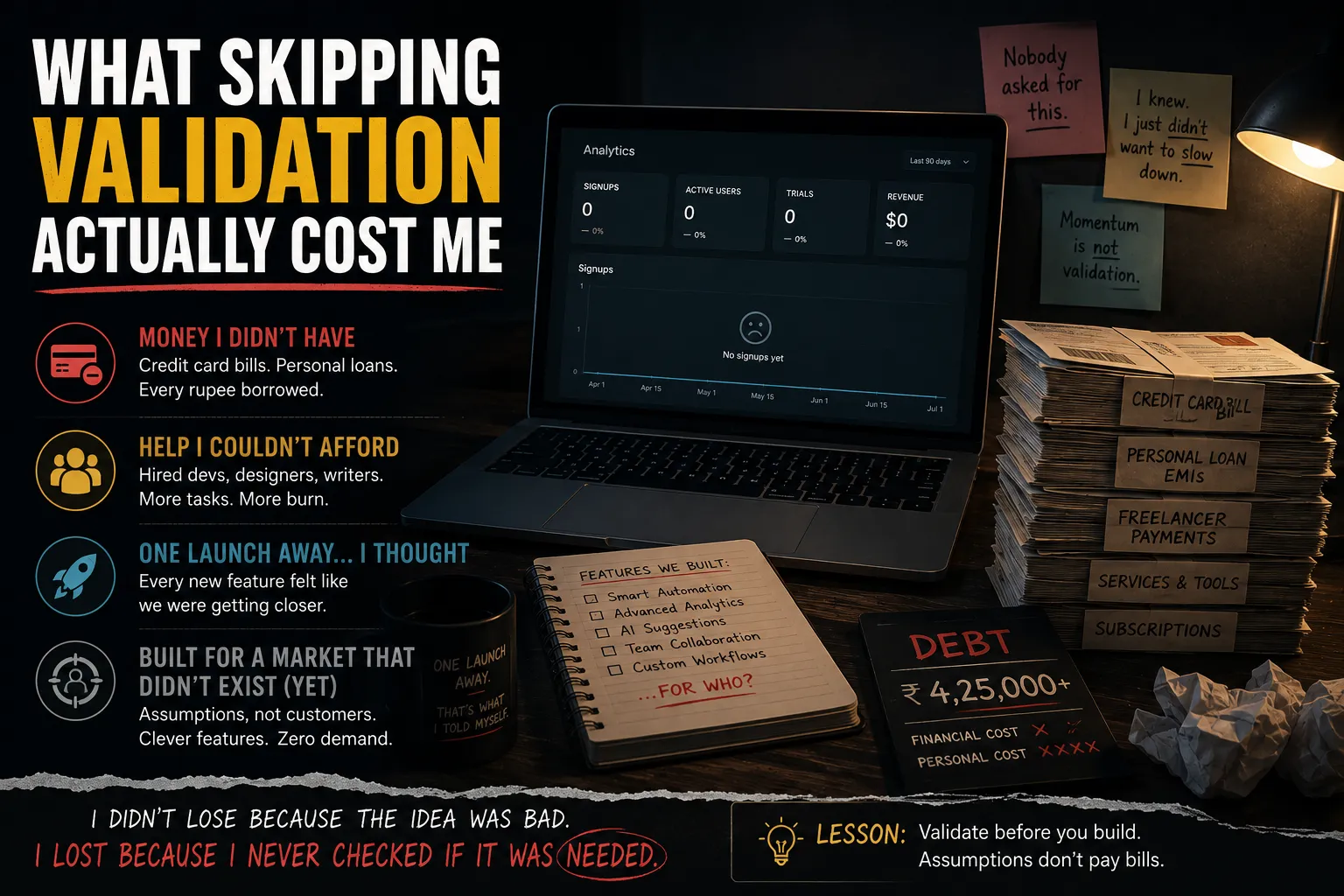
The part that's harder to admit: I knew, somewhere underneath the excitement, that I hadn't actually confirmed anyone wanted this. I just didn't want to slow down long enough to find out. Momentum felt like progress. It wasn't — it was just spending, dressed up as motion.
Faking Fine While It Was Falling Apart
I told friends and family I was doing fine while I was quietly spiraling. Part of that was pride. Part of it was not wanting to admit, out loud, that the thing I'd bet money and time on wasn't working. Saying "it's not working" felt like saying "I was wrong to try," and I wasn't ready to say that yet.
That silence made it worse. The people around me could have offered perspective — or at least the reality check that a stranger asking "wait, who's this actually for?" would have given me for free, months earlier. Instead I stayed inside my own certainty until the numbers made the certainty impossible to keep.
If you're in the middle of this right now — quietly burning savings on something nobody's asked for, and not telling anyone — that isolation is doing as much damage as the debt is. Talking to someone, even just one honest conversation, is worth more than another week of building alone.
Why "No One Cared" Wasn't About the Product
It's tempting to blame the UI, the onboarding, the marketing. I did all three, for a while. None of it was the actual problem. The actual problem was upstream of all of it: I hadn't found a real, specific, already-existing pain that people were actively trying to solve. I'd found a problem I found interesting to build for, which is a completely different thing.
A clean interface doesn't create demand. Clever features don't create demand. Demand is either already there, in the form of a problem someone's actively frustrated by, or it isn't — and no amount of execution manufactures it after the fact.
The Validation I Skipped, in Plain Terms
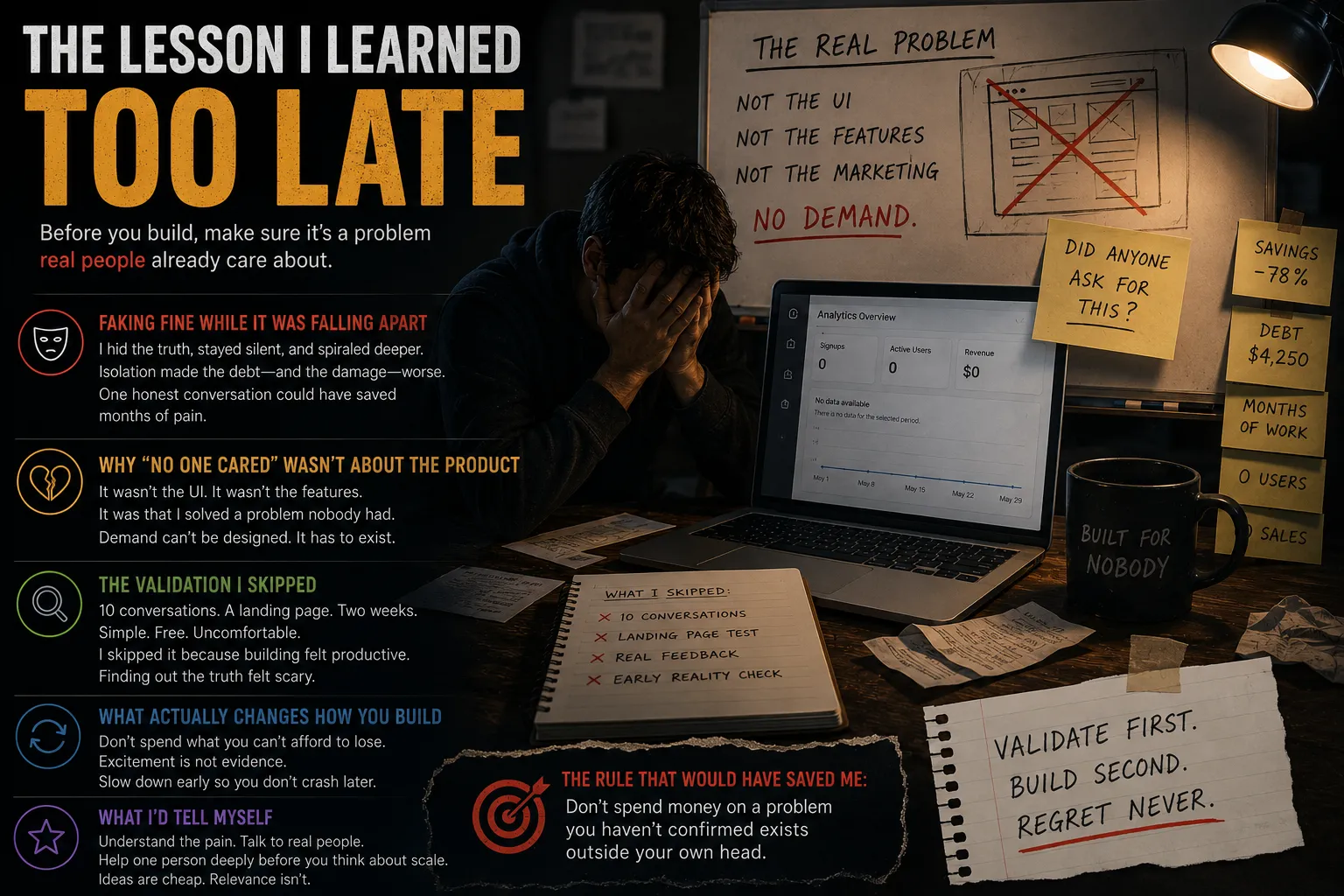
Looking back, "validation" didn't need to mean a formal research process. It could have been embarrassingly small: ten conversations with people who had the problem I thought I was solving, asked in a way that let them tell me I was wrong. A landing page with a real call to action, sitting untouched for two weeks, would have told me more than any amount of building did.
None of that requires money. That's what makes skipping it so avoidable in hindsight and so easy to skip in the moment — it doesn't feel productive the way writing code does. Code produces something you can point to. A validation conversation just produces information, and information that might tell you to stop doesn't feel like progress while you're chasing a launch date.
If I'd done even a rough version of this before spending anything, I either would have found the real problem underneath my assumption, or I would have found out early — for free — instead of finding out late, in debt.
What Actually Changes How You Build After This
The lesson isn't "validate more" as an abstract virtue. It's specific: don't spend money you can't afford to lose on a problem you haven't confirmed exists outside your own head. That's a much narrower rule than "always validate," and it's the one that would have actually stopped me.
It also means treating early excitement as a reason to slow down, not speed up. The ideas that feel the most obviously good are exactly the ones I'm least likely to question — which is precisely why they need the most scrutiny, not the least. Confidence isn't evidence. It just feels like evidence from the inside.
What I'd Tell Myself Before Building Again
You cannot bypass the grind of deeply understanding a customer's pain. You cannot outsource validation to a hired contractor or a slicker landing page. And you cannot skip learning how to actually help one real person before you try to scale that help into a business.
Ideas are cheap and easy to get excited about. Execution, validation, and relevance are the hard, unglamorous parts — and they're the parts that were missing the entire time I was spending money I didn't have.
I'm not saying SaaS is a bad path. It's just not what the internet makes it look like. It's not a shortcut, and it's not passive. If you're chasing a million-dollar idea right now, stop before you spend a dollar you can't afford to lose, and make sure it solves a real problem for real people who've already told you, in some form, that they're stuck without it.
I learned this one too late. I'm writing it down so you don't have to.
For more on the decisions that go into what gets built (and what doesn't), see more Startups & Indie Hacking posts.
FAQ
Frequently asked questions
Why do most SaaS ideas fail even when the product is well-built?
Most SaaS ideas fail because the product was never tested against a real, already-existing pain point before it was built. A clean UI and clever features don't create demand — demand either already exists as a problem people are actively trying to solve, or it doesn't, and good execution can't manufacture it afterward.
How do you know if a SaaS idea is worth building without spending money?
Look for evidence the problem already exists and that people are already trying (and failing) to solve it — through workarounds, competitor complaints, or direct conversations with potential users — before writing any code. If you can't find anyone actively frustrated by the problem today, that's the signal to keep investigating, not to start building.
Is it normal to go into debt building a first SaaS product?
It's common, but it's not necessary. Debt usually comes from treating spending (on hosting, contractors, tools) as proof of progress rather than tying every dollar spent to a validated signal that someone wants the product. Founders who validate before spending tend to spend far less in the early stage.
What should I do if I'm currently burning savings on a SaaS nobody's using?
Talk to someone before you spend more — a friend, a mentor, or even a stranger who fits your target user. Isolation makes it easy to keep justifying the spending to yourself. Getting outside perspective, even one honest conversation, is usually enough to see clearly whether the problem is the marketing or the idea itself.
Written by Jenarius Ganlary
Full-stack developer and MIS & Data Analyst, building CreatorBit and freelancing through Ganlary Labs. Writing about SaaS, AI, and startups as it happens.
More about me →KEEP READING