AEO and GEO Are Just SEO, Google Confirms
· 13 min read
Back in May, Google put out its first official guidance on the AEO/GEO question everyone in the SEO industry has been arguing about for two years: is optimizing for AI search actually a different discipline, or is it just SEO wearing a new acronym? Google's answer was short. "In short, yes" — SEO is still relevant, and AEO and GEO are treated as extensions of it, not replacements. I read that and had a weirdly anticlimactic reaction: I didn't need to change anything. Not because I'm already some SEO expert, but because the rules I'd been following for this blog — write the answer first, structure headings so they stand alone, format the FAQ so a machine can lift it cleanly — were already the thing Google just described. So instead of writing a generic "here's what AEO and GEO mean" explainer, I want to walk through what actually changed this year, what didn't, and where I think solo developers writing their own content are wasting time chasing the wrong fix.
What Google Actually Confirmed About AEO and GEO
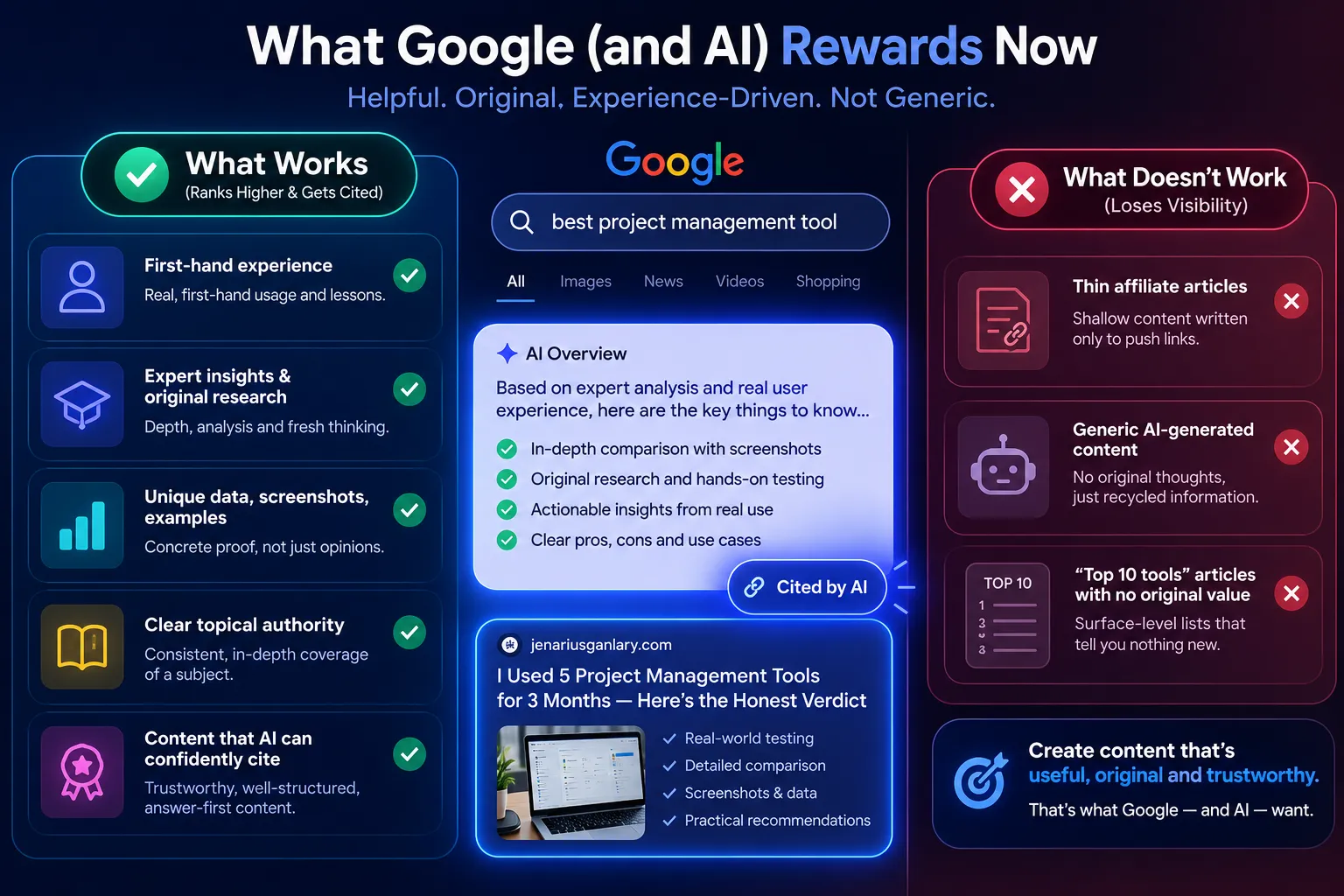
The short version: Google's May 2026 guidance states that AI-powered search experiences aren't a separate playbook from traditional SEO. The same fundamentals — crawlable pages, genuine authority, content that's actually useful — are what get you surfaced in AI Overviews and cited inside AI Mode, ChatGPT, or Perplexity responses. There isn't a secret file format or a hidden meta tag that unlocks AI visibility. If your content is thin, generic, or written to game a checklist, it was never going to work for classic SEO either, and it definitely doesn't work now.
This matters because an entire cottage industry sprang up around the opposite assumption — that AI search needed its own special tricks. Content chopped into "AI-digestible" chunks. Copy rewritten to sound machine-friendly instead of human-friendly. Special text files nobody asked for. Google's statement is basically a correction: none of that was ever the actual lever. The lever was always whether the content answers the question well enough that a person (or a model synthesizing an answer for a person) can trust it and use it.
For someone writing every post on their own blog by hand, this is good news. It means you don't need a subscription to a content-scoring tool to compete. You need to write clearly, structure the page so the important information isn't buried, and actually know what you're talking about.
AEO vs GEO: The Distinction Most Guides Get Wrong
Almost every article on this topic uses AEO and GEO interchangeably, which muddies what's actually different between them.
AEO (Answer Engine Optimization) is about being selected as the direct answer — the featured snippet, the AI Overview box, the voice search response. GEO (Generative Engine Optimization) is about being cited as a source inside a longer generated response, where the AI is synthesizing an answer from several pages and attributing parts of it back to you.
The same piece of content can win both, and usually does, because the underlying requirements overlap: clear structure, a direct answer near the top of each section, and enough specific, verifiable detail that the model doing the synthesizing has a reason to trust your page over a competing one. But they're measured differently. AEO shows up as "did my content get pulled into the answer box." GEO shows up as "how often do AI tools mention or link back to me when answering a related question" — something people are now calling share of voice in AI answers, and treating as the new stand-in for the old "rank #1" obsession.
The practical difference matters if you're trying to diagnose why something isn't working. If you're getting cited by AI tools but not showing up in Google's own AI Overview box, that's an AEO gap specific to Google's system, not a general content problem. If you're ranking fine on Google but ChatGPT and Perplexity never mention you, that's more about how those tools weigh trust signals and cross-web consistency — GEO — which can be a slower, harder thing to move.
The June 2026 Spam Update Targeted Scaled Content Abuse, Not "AI Content" Itself
Two other things happened this year that are worth being precise about, because a lot of coverage blurs them together.
The May 2026 core update ran from May 21 to June 2 — about twelve days — and multiple analysts who track these things called it more turbulent than the March update earlier in the year. Google didn't publish specifics on what it targeted, which is standard practice for core updates: they're broad recalibrations of how the ranking systems weigh quality, relevance, and trust across the entire web, not a fix for one named violation.
The June 2026 spam update came about three weeks later, running June 24–26. This one is where I want to be careful with the framing, because I've seen it described as "combatting AI-generated thin content" in a way that overstates what Google actually said. Google's own announcement was brief: a global rollout, applying to all languages, targeting violations of existing spam policies through its SpamBrain detection system. Coverage generally describes the target bucket as scaled content abuse, cloaking, sneaky redirects, and similar manipulative tactics — a bucket that does include mass-produced AI spam, but Google didn't specifically announce "we are now hunting AI-generated content." That's an inference several outlets are making, not a direct quote.
The distinction actually matters for what you do next. A spam update enforces existing, specific policies — if you're not doing scaled content abuse or cloaking, there's nothing to "recover" from because you were never targeted. A core update is a broad quality recalibration with no single fix; the only real response is raising the actual quality of what you publish over time. Conflating the two leads to people "fixing" the wrong problem, which is a mistake I've seen described in more than one recovery guide this year — teams applying spam-policy fixes to what was actually a core-update quality issue, or vice versa.
Why the Volatility Doesn't Mean What Solo Bloggers Think It Means
If you're a one-person blog and you saw traffic wobble in June, it's tempting to read that as "the algorithm is punishing small sites" or "I need to restructure everything right now." I don't think that's the right read, and here's why.
Both updates this year were framed around the same target: manipulative or low-effort content produced at scale. That's a description of content farms, programmatic SEO operations, and sites publishing hundreds of AI-drafted articles a week with minimal editing. It is not a description of a developer writing roughly one substantive post a day about things they've actually built and shipped. The volatility genuinely targeted at scaled abuse doesn't touch a blog like this one in any structural way — if anything, a genuinely tighter enforcement environment for thin AI content should be good for anyone still writing with real specifics, because there's less noise crowding out the pages that actually answer the question.
Where I'd actually pay attention is Google's parallel move to make Gemini 3.5 Flash the default model inside AI Mode across Search, the Gemini app, and the API — announced at I/O and rolled out globally. The reported benchmarks put it ahead of the previous Pro-tier model on agentic and multimodal tasks while running noticeably faster. Practically, that means the model actually reading and synthesizing your page into an AI Overview answer got measurably better at parsing and reasoning about content this year. A stronger synthesizing model is more likely to correctly extract a genuinely well-structured direct answer — and more likely to correctly skip over a page that's padded, vague, or structured to game a scanner rather than answer a human.
What I Actually Changed on My Blog After Reading the Confirmation
Honestly, close to nothing, and I think that's the more useful thing to say than pretending I overhauled anything.
The habits I already had — direct-answer-first sections, descriptive standalone headings, an FAQ section phrased the way people actually type questions instead of the way I'd phrase them as an article title — weren't built because I predicted this Google statement. They were built because I got tired of writing the way I used to: long throat-clearing intros before getting to the point, headings like "More Thoughts" that meant nothing out of context, FAQs that were really just three more paragraphs with a question mark stapled to the front. Fixing that made the posts better for a human skimming on their phone, and it turns out it's the exact same fix that makes a post easier for a model to extract and cite correctly.
That's really the whole thesis of Google's May guidance, if you strip the acronyms out: write for a person who's in a hurry and needs the actual answer, not a person who wants to be sold to for three paragraphs first. Do that consistently, and you're accidentally doing AEO and GEO correctly, because those disciplines were describing "good writing, formatted so it doesn't have to be excavated" the whole time.
The Part Nobody Selling You an AI-Optimizer Tool Wants You to Notice
There's a real market right now of tools that will scan your post and hand you a score — an "AI Visibility Score," a citation-worthiness rating, a list of "missing entities" to insert. Some of them are genuinely useful for teams managing hundreds of pages who need to triage where to spend editing time. I don't think they're necessary for a solo blog putting out one or two posts a day, and I want to be honest about why, instead of just dismissing them.
The value these tools provide is mostly about scale — flagging patterns across a large content library faster than a human could read through it manually. When you're the only person writing and you already reread your own draft before publishing, you're the tool. You already know if a section buries the answer in paragraph three, because you just wrote paragraph three. The checklist these products are automating — direct answer near the top, clear entity naming, FAQ formatted to be extractable — is short enough to just internalize and apply while you write, rather than write first and then run a $50/month scanner over it to tell you what you already suspected.
[SCREENSHOT NEEDED: screenshot of Google's Search Status Dashboard entry for the June 2026 spam update, showing the "Released the June 2026 spam update, which applies globally and to all languages" announcement text]
Where I'd actually spend money as a solo dev, if I were going to spend any, is on a citation-tracking tool to see whether ChatGPT, Perplexity, or Gemini already mention me for queries I care about — because that's genuinely hard to check by hand, unlike "does my FAQ answer stand alone," which isn't. If you want a broader take on which paid tools are actually worth it at the solo-developer stage versus which ones are subscription bloat, I wrote about that trade-off in 5 Tools Every Solo Developer Should Actually Pay For — the same "is this solving a real bottleneck or just a nice-to-have" test applies here.
The Direct-Answer Rule I Already Follow, and Why It Works
The rule is simple enough that it sounds almost too obvious to write down: whatever question the heading implies, answer it in the first two or three sentences under that heading. Not the fifth sentence. Not after a paragraph of context-setting. The answer, then the context and nuance after.
I didn't invent this — it's the same instinct behind the old inverted-pyramid rule in journalism, lede first, details after. What's different now is the cost of getting it wrong is higher than it used to be. A human reader annoyed by a slow intro will scroll to find the point. A model summarizing your page for an AI Overview doesn't scroll with patience — it extracts what looks like the answer from wherever the structure suggests the answer should be, and if that's buried, it either grabs the wrong sentence or skips your page for one that made it obvious.
The FAQ section works on the same logic, just more literally. Each question needs to be phrased the way someone would actually type it into a search box or ask a chatbot, not the way I'd naturally phrase it as a subheading. And the answer underneath needs to be a complete, self-contained paragraph — no "as mentioned above," no pronoun that only makes sense if you read the rest of the article. Every answer should be able to survive being lifted out of the post entirely and dropped into someone else's chat window, because that's exactly what's happening to it now.
Where I Do Think Solo Developers Should Pay Attention
I don't want this to read as "nothing matters, just write well and ignore the news," because there are a couple of things worth genuinely tracking, even at the one-person-blog scale.
Entity consistency is the one I'd flag first. If your name, your project names, your company gets described slightly differently across your own site, your GitHub, your LinkedIn, and any guest posts, that inconsistency makes it harder for a model to confidently connect the dots and cite you as the authoritative source on a topic. That's a five-minute audit, not a rebuild — check that "CreatorBit" and "Ganlary Labs" are described the same way everywhere you've mentioned them.
The second is watching how differently each AI platform actually sources its answers, because treating them as one blob called "AI search" misses real variation. Recent testing found Perplexity tends to pull from a wide spread of third-party directories, review sites, and forum threads rather than leaning on any single article — a genuinely different citation pattern than Google's AI Overviews, which lean more heavily on top-ranking organic results, or Copilot, which reportedly leans on LinkedIn for a lot of B2B-style queries. If you only ever check "am I ranking on Google," you're blind to whether Perplexity or Copilot are surfacing you at all, and the fix for each isn't identical.
The last thing, and maybe the most boring but most important: don't build a strategy around one citation win. If you land a mention in an AI Overview or get cited by ChatGPT for a specific query, that's genuinely fragile — a handful of pages can absorb most of the citations for a given topic at any moment, and that concentration shifts. Treat it as a nice outcome of writing something genuinely useful, not a permanent asset you can stop maintaining.
Closing Thought
The most reassuring part of Google's confirmation, for me, is that it removes the pressure to keep chasing a moving target that never actually existed as a separate thing. AEO and GEO aren't a new curriculum to master before your next post. They're a description of what happens when you already write the way you should have been writing anyway — answer first, structure that doesn't hide the point, and genuine specifics instead of padding. If you're a solo developer writing your own blog, the actual unlock isn't a new tool subscription. It's just not wasting the reader's time, and trusting that the same thing that respects a human's time also respects whatever model is reading it next.
For more posts on the tools, workflow, and decisions that go into building this blog and the rest of what I'm working on, see more Tech & Developer Life posts.
FAQ
Frequently asked questions
Is AEO different from SEO?
Not according to Google's own May 2026 guidance — the company stated directly that SEO is still relevant for generative AI search, and that AEO and GEO are extensions of the same fundamentals rather than a separate discipline. AEO specifically refers to being selected as the direct answer in features like AI Overviews or featured snippets, while classic SEO covers the broader foundation of crawlability, authority, and content quality that both AEO and GEO depend on.
What is the difference between AEO and GEO?
AEO (Answer Engine Optimization) is about getting selected as the direct answer shown to a user, such as in a featured snippet or an AI Overview box. GEO (Generative Engine Optimization) is about being cited as a source inside a longer AI-generated response, such as an answer from ChatGPT or Perplexity that references or links back to your page. The same well-structured content often wins both, but they're measured and diagnosed differently.
Did the June 2026 Google spam update target AI-generated content?
Google's official announcement described it as a global rollout targeting violations of existing spam policies through its SpamBrain system, without naming AI-generated content specifically. Most coverage describes the targeted bucket as scaled content abuse, cloaking, and similar manipulative tactics, which does include mass-produced AI spam, but that framing is an inference from outside analysts rather than a direct quote from Google.
Do I need an AI SEO tool to optimize my blog for AI search?
Not necessarily, especially at the scale of a single writer publishing their own content. The core requirements — a direct answer near the top of each section, descriptive standalone headings, and an FAQ formatted so each answer stands alone — are simple enough to apply while writing, without a paid content-scoring subscription. Those tools tend to earn their value at the scale of managing dozens or hundreds of pages, where manually rereading everything isn't practical.
Written by Jenarius Ganlary
Full-stack developer and MIS & Data Analyst, building CreatorBit and freelancing through Ganlary Labs. Writing about SaaS, AI, and startups as it happens.
More about me →KEEP READING