OpenAI Codex vs. Claude AI in 2026: Which Coding Agent Should You Actually Use?
· 7 min read
OpenAI Codex and Claude Code solve the same problem — an AI agent that writes, tests, and ships code with less hand-holding — from two different starting points. Codex runs in the cloud and works asynchronously while you do something else; Claude Code lives in your terminal and works alongside you in real time. Neither is strictly "better." The right one depends on how you actually work, not which benchmark number is higher this month.
This isn't a marketing comparison. Both tools have shipped major updates through 2026, and the gap between what they're good at has actually gotten more specific, not less. Here's what matters if you're choosing one for real work.
What OpenAI Codex and Claude Code Actually Are
OpenAI relaunched Codex as a full coding agent in 2025, and it now runs on the GPT-5.6 model family. Codex operates primarily as a cloud-based agent: you hand it a task, it works in an isolated sandbox, and you review the diff when it's done. As of August 2026, Codex also ships an Appshots feature in its macOS app that lets you attach a live app window — including screenshots and visible text — to a Codex thread, and a mobile companion that mirrors the state of a running session (approvals, terminal output, diffs, test results) so you can steer work from your phone.
Claude Code, Anthropic's terminal-first coding agent launched in May 2025, is built around working in real time next to you — in the terminal, but also integrated into VS Code, JetBrains IDEs, the Claude desktop app, and the browser. It runs on Anthropic's Claude model family: Opus, Sonnet, Haiku, and Fable 5.
The philosophical difference matters more than it sounds: Codex is designed around "kick off a task and check back later," while Claude Code is designed around "work through this problem with me right now." Goal mode, now generally available across the Codex app, IDE extension, and CLI, pushes Codex further toward autonomy — you define an outcome and success criteria and let it keep working until it's met.
Benchmarks: What the Numbers Actually Show
Benchmark season in 2026 has been close, and neither model has a clean win across every board.
GPT-5.5 (powering Codex) leads Terminal-Bench 2.0 at 82.7% versus Claude's 69.4%, and edges out SWE-bench Verified 88.7% to 88.6% — essentially a tie. Claude Opus 4.8 (powering Claude Code) leads SWE-bench Pro 69.2% to 58.6%, and reads a full 1M-token context window against Codex's 200K.
The catch with these numbers: SWE-bench Verified uses a curated, more controlled set of problems, while SWE-bench Pro uses harder, real-world, multi-file problems closer to what you'd hit in a large production codebase. If your work looks like isolated, well-scoped tickets, Codex's benchmark edge is more representative. If your work looks like sprawling, multi-file refactors in a codebase with a lot of implicit context, Claude's SWE-bench Pro lead and larger context window are more representative.
A 500+ developer Reddit survey from mid-2026 adds a useful wrinkle: 65% of developers said they preferred using Codex day to day, but blind reviews of the actual code produced rated Claude Code's output cleaner 67% of the time. Read that as: Codex feels faster and more convenient to work with, but Claude's output needs less cleanup afterward. Which one you value more depends on whether your bottleneck is initiating tasks or reviewing them.
Multi-Agent Workflows: Subagents vs. Agent Teams
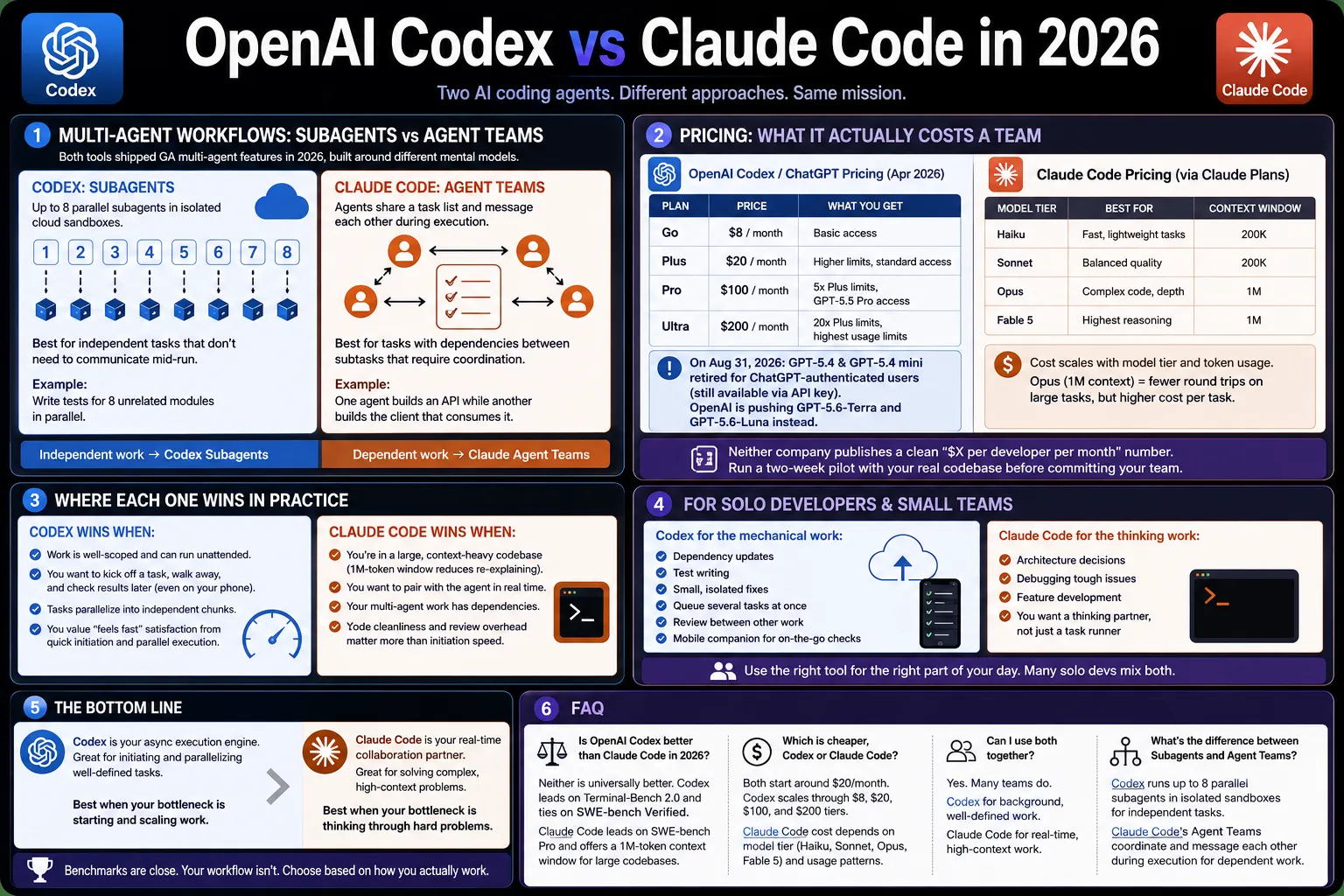
Both tools shipped GA multi-agent features in 2026, and they're built around different mental models.
Codex runs up to 8 parallel subagents in isolated cloud sandboxes — good for fanning a large task out into independent chunks that don't need to talk to each other mid-run (say, writing tests across 8 unrelated modules at once).
Claude Code runs Agent Teams, where multiple agents share a task list and message each other during execution — better suited to work that has dependencies between subtasks, like one agent scaffolding an API while another writes the client that consumes it, coordinating as both progress.
If your team's work parallelizes cleanly into independent chunks, Codex's subagent model is simpler and probably faster. If your work has real dependencies between the pieces, Agent Teams' shared coordination is the better fit — you'll spend less time manually stitching results back together.
Pricing: What It Actually Costs a Team
Both tools start at $20/month, but the structure above that tier is different enough to matter for budgeting.
OpenAI restructured Codex/ChatGPT pricing in April 2026 into four tiers: Go at $8/month, Plus at $20/month, Pro at $100/month (5x Plus limits, GPT-5.5 Pro access), and a $200/month tier with 20x the base limits. On August 31, 2026, GPT-5.4 and GPT-5.4 mini are being retired from Codex for ChatGPT-authenticated users (they remain available via API key), with OpenAI pushing users toward GPT-5.6-Terra and GPT-5.6-Luna instead — worth knowing if you have workflows pinned to a specific model version.
Claude Code pricing follows Anthropic's Claude subscription tiers, also starting around $20/month, with usage scaling by model tier (Haiku, Sonnet, Opus, Fable 5) and context/token consumption. The key budgeting difference: Claude Opus's 1M-token context window means fewer round trips on large-context tasks, but Opus-tier usage costs more per task than Sonnet or Haiku — so a team's actual monthly cost depends heavily on which model tier they default to, not just the plan they're on.
Neither company publishes a clean "$X per developer per month" number that holds across usage patterns, so the honest advice is: run a two-week pilot with your actual codebase and workload before committing a whole team to either.
Where Each One Wins in Practice
Codex wins when: Work is well-scoped and can run unattended. You want to kick off a task, walk away, and check results later from your phone. Your team's tasks parallelize into independent chunks. You're optimizing for developer-reported "feels fast" satisfaction over raw output cleanliness.
Claude Code wins when: You're working in a large, context-heavy codebase where a 1M-token window meaningfully reduces re-explaining. You want to pair with the agent in real time rather than review a diff after the fact. Your multi-agent work has real dependencies between subtasks. Code cleanliness and review overhead matter more to you than initiation speed.
Realistically, a lot of teams in 2026 are running both — Codex for background, well-defined tasks (test coverage, dependency bumps, isolated bug fixes) and Claude Code for the real-time, high-context work (feature development, refactors, debugging sessions) where you want an agent thinking alongside you rather than off in a sandbox. If your budget allows it, that combination captures more of each tool's strengths than picking one exclusively.
For Solo Developers and Small Teams
If you're a solo builder or a two-to-three person team, the calculus tilts differently than it does for a larger engineering org. You don't have the luxury of running both tools in parallel workflows without thinking about cost, and you're usually context-switching between many small tasks rather than running large coordinated multi-agent jobs.
For that profile, Codex's async model is arguably a better fit for the mechanical parts of the job — dependency updates, test writing, small isolated fixes — because you can queue several at once and review them between other work, including from your phone via the mobile companion. Claude Code earns its keep on the parts of solo development that are genuinely collaborative in nature: architecture decisions, debugging a gnarly issue, or working through a feature where you want a thinking partner rather than a task runner. Many solo developers end up defaulting to whichever tool matches their current task rather than committing fully to one.
The Bottom Line
Neither Codex nor Claude Code is a clear universal winner in 2026 — they're optimized for different modes of working. Codex is the better fit if your bottleneck is initiating and parallelizing well-defined tasks; Claude Code is the better fit if your bottleneck is working through complex, high-context problems that benefit from real-time collaboration and produce code that needs less cleanup afterward. Benchmark scores are close enough on both sides that they shouldn't be the deciding factor — how your actual work is shaped should be.
For more on how these tools fit into a builder's day-to-day, see more Tech & Developer Life posts.
FAQ
Frequently asked questions
Is OpenAI Codex better than Claude Code in 2026?
Neither is universally better — they're built for different working styles. Codex leads on Terminal-Bench 2.0 and ties on SWE-bench Verified, making it strong for well-scoped, asynchronous tasks. Claude Code leads on SWE-bench Pro's harder real-world problems and offers a 1M-token context window, making it stronger for large, high-context codebases and real-time collaboration.
Which is cheaper, Codex or Claude Code?
Both start around $20/month at the entry tier. Codex's pricing scales through Go ($8), Plus ($20), Pro ($100), and a $200 tier with 20x limits. Claude Code's cost scales with which model tier you use — Haiku, Sonnet, Opus, or Fable 5 — so actual monthly cost depends more on usage patterns and model choice than the base plan price.
Can I use both OpenAI Codex and Claude Code together?
Yes, and many development teams do in 2026 — using Codex for background, well-defined tasks like dependency updates and isolated bug fixes, and Claude Code for real-time, high-context work like feature development and debugging. There's no technical conflict between running both in the same workflow.
What's the difference between Codex's subagents and Claude Code's Agent Teams?
Codex runs up to 8 parallel subagents in isolated cloud sandboxes, best suited for independent tasks that don't need to coordinate with each other. Claude Code's Agent Teams share a task list and message each other during execution, which works better for tasks with real dependencies between the pieces, like one agent building an API while another builds the client that consumes it.
Written by Jenarius Ganlary
Full-stack developer and MIS & Data Analyst, building CreatorBit and freelancing through Ganlary Labs. Writing about SaaS, AI, and startups as it happens.
More about me →KEEP READING