Apple's iPhone 18 Pro and iPhone Duo Are Here — Should You Actually Upgrade?
· 8 min read
Apple just opened pre-orders for the iPhone 18 Pro and Pro Max, and in October it's shipping its first-ever foldable, the iPhone Duo, at ₹2,99,900. I'm not going to pretend I bought one already — the phones aren't even in anyone's hands yet. But I've spent enough years staring at "No Cost EMI" banners while doing MIS work with budgets and payment schedules to know exactly what that phrase is doing to people's math, so let's actually do the math instead of skimming the spec sheet.
This isn't a review. It's the version of this post I wish existed before every big Apple launch: what genuinely changed, what it costs against a real Indian salary, and a straight answer on who should upgrade and who's better off sitting this one out.
What Actually Changed in the iPhone 18 Pro
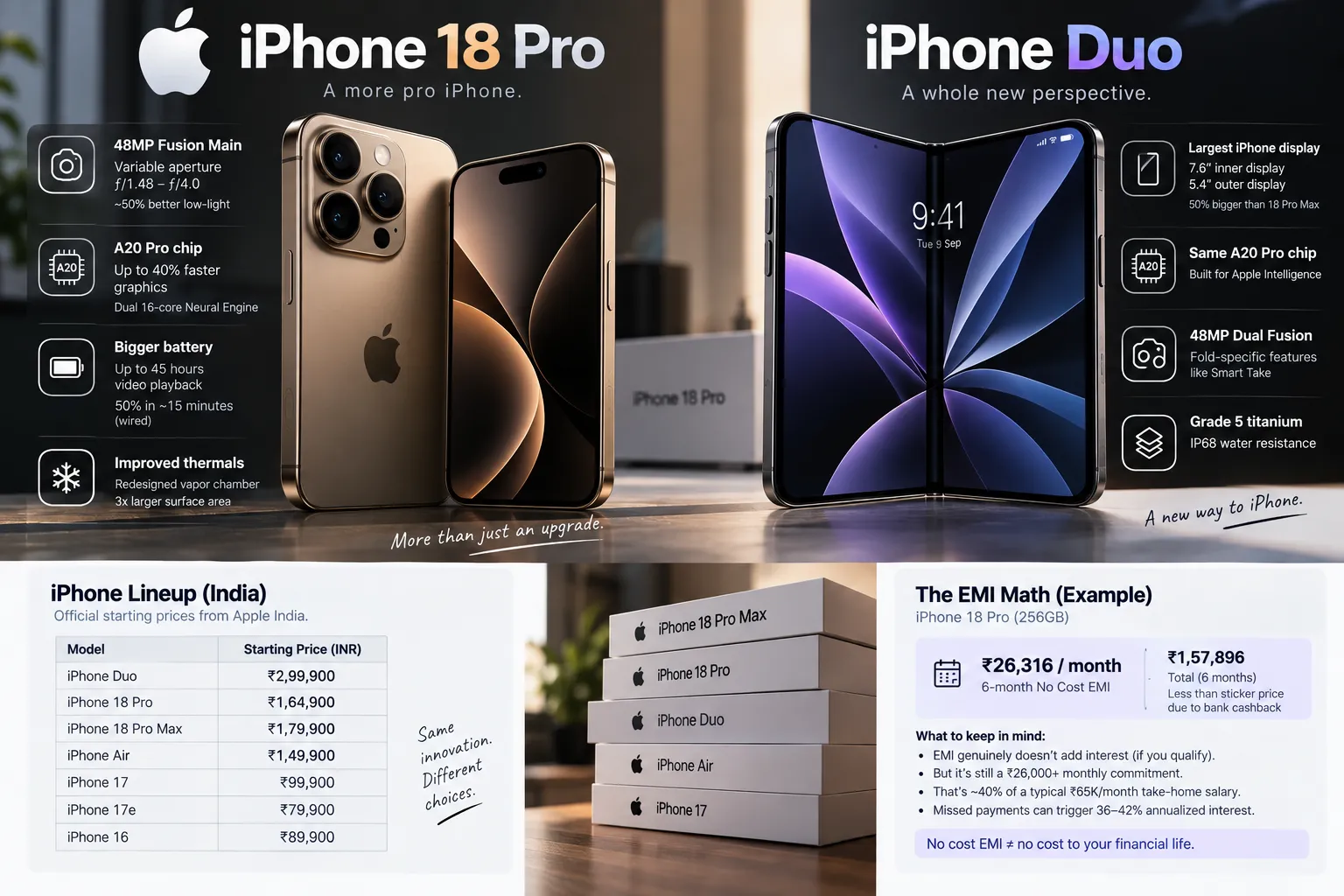
The headline upgrade is the camera. The 18 Pro's 48MP Fusion Main camera now has a variable aperture — four physical settings from ƒ/1.48 to ƒ/4.0 — which is a real hardware change, not a software trick. Apple's claiming roughly 50% better low-light performance over the 17 Pro, and a variable aperture is the kind of thing that actually matters if you shoot a lot in mixed lighting, because it changes depth of field, not just brightness.
The A20 Pro chip is up to 40% faster on graphics than the A19 Pro in the 17 Pro, with a dual 16-core Neural Engine that doubles on-device AI compute. That's the chip doing the heavy lifting for Apple Intelligence and Siri's newer features running fully on-device instead of round-tripping to a server.
Battery and thermals got a real bump too: the 18 Pro Max hits up to 45 hours of video playback (six hours more than last gen), 50% charge in about 15 minutes on wired charging, and a redesigned vapor chamber with 3x the surface area for sustained performance under load — which mostly shows up if you're gaming or doing long video exports on the phone.
Then there's the iPhone Duo — Apple's first foldable. Opened, it's the largest display Apple has ever put in an iPhone, 50% bigger than the 18 Pro Max's screen (7.6" inner, 5.4" outer). It runs the same A20 Pro chip, has a 48MP Dual Fusion camera system with fold-specific features like Smart Take, and comes in Grade 5 titanium with IP68 water resistance. It's a genuinely new form factor for Apple, not a spec bump — and it's priced like one.
The Real Price Table (India)
Here's what's actually on Apple's India store right now, no rounding:
| Model | Starting Price |
|---|---|
| iPhone Duo | ₹2,99,900 |
| iPhone 18 Pro | ₹1,64,900 |
| iPhone 18 Pro Max | ₹1,79,900 |
| iPhone Air | ₹1,49,900 |
| iPhone 17 | ₹99,900 |
| iPhone 17e | ₹79,900 |
| iPhone 16 | ₹89,900 |
And storage upgrades on the Pro line stack up fast — the 18 Pro goes from ₹1,64,900 (256GB) to ₹3,14,900 for 2TB. That's a ₹1.5 lakh swing for storage alone, on top of the base price.
The "No Cost EMI" Trap, With Actual Numbers
Here's where I want to slow down, because this is the part that actually costs people money.
Apple's own EMI calculator for the iPhone 18 Pro (256GB, ₹1,64,900) shows a 6-month No Cost EMI plan at ₹26,316/month. Do the multiplication: 6 × ₹26,316 = ₹1,57,896 — less than the sticker price, because the "no cost" comes from bank cashback and card-issuer subsidies baked into the offer (Apple's page specifically calls out Amex, Axis Bank, and ICICI Bank cards with up to ₹7,000 instant cashback).
So the EMI itself isn't lying to you — it genuinely doesn't add interest on top, assuming you qualify for the card and the offer. That's the part people get right. Here's the part they get wrong:
"No cost" doesn't mean "no cost to your monthly cash flow." You're still committing ₹26,000+ out of your bank account every month for half a year, on a card, for a phone. That's not a rounding error against a normal Indian tech salary — it's a structural chunk of it.
Average software engineer pay in India sits around ₹9.5L/year (₹5L–₹15.1L range), which works out to roughly ₹65,000–₹70,000/month take-home after tax for a mid-band earner. A ₹26,316 EMI on a 256GB iPhone 18 Pro is close to 40% of that take-home pay, every month, for six months — before rent, SIPs, loan EMIs you might already be carrying, or literally anything else.
For a fresher earning closer to ₹4–5L/year (₹30–35K/month take-home), the same EMI is not viable at all without going in on credit-card revolving debt the moment the No Cost period ends or a payment gets missed — and that's where "no cost" quietly becomes very costly, because missed EMI payments on a card default to the card's regular interest rate, which in India routinely runs 36–42% annualized.
The trap isn't the EMI structure. It's that "no cost" gets read as "no consequence," and a ₹1.65L purchase gets evaluated on a monthly-payment basis instead of a total-cost-against-income basis — which is exactly how EMI marketing is designed to make you think about it.
A Quick Framework: EMI as a Share of Take-Home
If you're going to finance a phone at all, here's the check I'd actually run before hitting "buy," and it takes thirty seconds:
- Take your monthly take-home pay.
- Divide the monthly EMI by it.
- If that number is above ~15%, you're financing a phone, not smoothing a payment.
At ₹65K/month take-home, 15% is about ₹9,750/month — which doesn't get you anywhere near a Pro model on a 6-month plan. It gets you close to an iPhone 17 or 17e on a longer tenure, or it tells you the Pro needs to wait a pay cycle or two, or needs to come out of savings instead of a card.
This isn't a moral judgment about buying nice things. I like well-made hardware as much as the next person who spends all day looking at screens. It's just that "No Cost EMI" is specifically engineered to remove the number that would normally make you hesitate, and running your own 15% check puts that number back where you can see it.
Who Should Actually Upgrade
Be honest about which of these is actually you:
- You're on an iPhone 15 or older and your battery health has visibly degraded. Two generations plus battery wear is a real, felt difference — not a marketing one.
- You shoot photo or video for work or content and the variable aperture genuinely changes your output. If low-light or depth control is a real constraint in what you make, the 18 Pro's camera system is a legitimate upgrade, not a nice-to-have.
- You do sustained on-device compute — video export, on-device model inference, heavy AR/gaming — where the A20 Pro's 40% graphics gain and better thermals show up in actual wait time saved.
- You can pay for it without touching an EMI at all, or the EMI comfortably clears the 15% check above. If the money's already there, the calculus is just "is this worth it to me," which is a completely different — and much simpler — question.
Who Shouldn't
- You're on an iPhone 16 or 17. The generational gap here is real but not transformative for typical daily use — messaging, browsing, social, most apps. You will not feel this upgrade in your day-to-day the way the price tag suggests you should.
- The EMI is your only path to affording it. If a ₹1,65,000+ phone is only reachable by financing it, that's the clearest signal that it isn't currently affordable — the EMI is making a "no" feel like a "yes."
- You're chasing the foldable because it's new. iPhone Duo is a genuinely new form factor, which also means it's a first-generation product at a ₹2,99,900 starting price. First-gen Apple hardware historically gets meaningfully better by gen two or three — the crease, the software adaptation, third-party app support for the fold, all of it. Paying flagship-plus pricing to beta-test a form factor is a specific kind of decision, and it's fine to make it with eyes open, but it's rarely the "should" answer for most people.
The Actual Question to Ask Yourself
Strip away the keynote and the camera comparisons, and the decision comes down to one honest sentence: would I buy this in cash, this month, if EMI didn't exist as an option?
If the answer's yes, buy it — the EMI structure genuinely doesn't cost you extra as long as you clear the payments on schedule. If the answer's no, and EMI is the thing making it feel possible, that's not a financing tool doing its job. That's exactly the gap it's designed to paper over, and it's worth sitting with the "no" instead of letting a monthly number talk you out of it.
I think about builder-side money math the same way when I'm planning cash flow for a project — the framework doesn't change just because the thing you're buying is a phone instead of infra. If you want the fuller version of that thinking, see more Tech & Developer Life posts on the site.
FAQ
Frequently asked questions
Is No Cost EMI on the iPhone 18 Pro actually free, or is there a hidden cost?
The EMI structure itself is genuinely interest-free when you qualify — Apple's ₹26,316/month plan for the 256GB iPhone 18 Pro totals less than the ₹1,64,900 sticker price because bank cashback offsets it. The hidden cost isn't interest; it's the monthly cash-flow commitment, which for a typical Indian tech salary can run close to 40% of take-home pay for six months.
What's actually different between the iPhone 17 Pro and iPhone 18 Pro?
The biggest change is a variable-aperture 48MP main camera (ƒ/1.48 to ƒ/4.0) for better low-light and depth control, an A20 Pro chip that's up to 40% faster on graphics, roughly six more hours of battery life on the Pro Max, and a redesigned vapor chamber for better sustained performance. If you're not shooting a lot of low-light photo/video or running heavy on-device compute, most of this won't be visible in daily use.
Should I wait for the iPhone Duo or buy the iPhone 18 Pro now?
The Duo is Apple's first foldable, starting at ₹2,99,900, and first-generation Apple hardware typically improves significantly by its second or third iteration in build, software polish, and app support. Unless the folding form factor solves a specific problem for you today, the 18 Pro or a non-Pro model is the lower-risk buy right now.
How much of my salary should a phone EMI realistically take up?
A useful ceiling is about 15% of your monthly take-home pay. Above that, you're financing the phone rather than smoothing an affordable payment, and any missed payment risk exposes you to card interest rates that commonly run 36–42% annualized in India.
Written by Jenarius Ganlary
Full-stack developer and MIS & Data Analyst, building CreatorBit and freelancing through Ganlary Labs. Writing about SaaS, AI, and startups as it happens.
More about me →KEEP READING