I Tried to Buy a Laptop and the AI Chip Shortage Won
· 4 min read
I went into a laptop purchase thinking it would take an afternoon. Pick a spec sheet, compare two or three models, buy the one that made sense for the money. Instead I spent almost two weeks going back and forth, watching listings change price between browser tabs, and eventually accepting that the laptop market right now has almost nothing to do with the laptop market I remembered from even a year ago.
This isn't a "why are prices high" explainer, and it isn't a buying framework either — I already wrote both of those in Why RAM Prices Are So High. This is the messier, less structured version: what it actually looked like to try to buy a machine in the middle of that market, in real time, before I'd fully processed how bad it had gotten.
What I Was Actually Shopping For
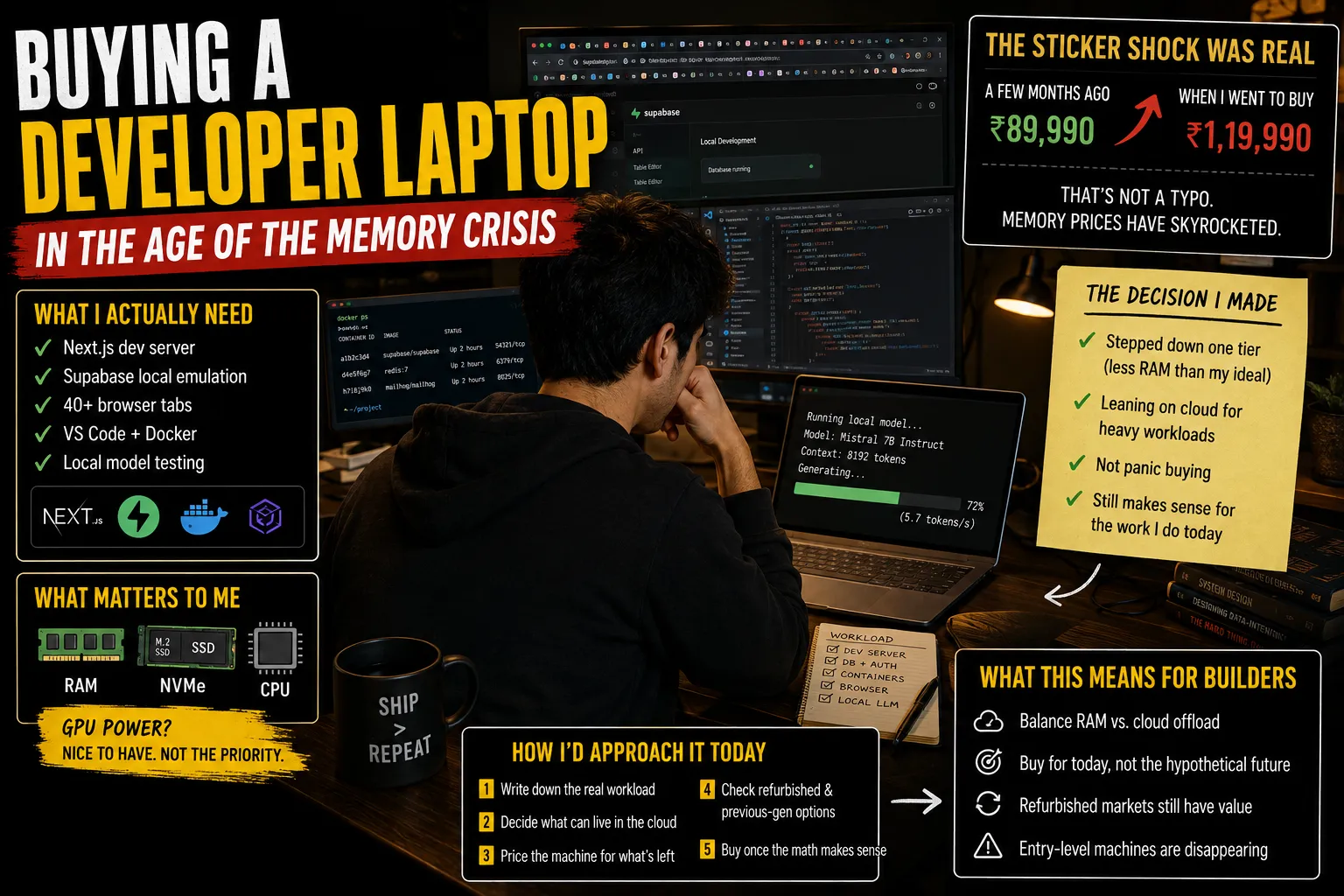
I wasn't buying a gaming laptop or a general-purpose family PC. I needed something that could handle the actual day-to-day of my work: running a Next.js dev server with Supabase local emulation, keeping a browser with forty tabs open next to VS Code and a couple of Docker containers, and occasionally running a local model for testing before I burn API credits on the hosted version. None of that is exotic. It's just what building software with modern tooling requires now, and it means RAM and a decent SSD matter more to me than GPU horsepower ever will.
Two years ago that spec — 32GB RAM, a fast NVMe drive, a mid-range but modern CPU — sat comfortably in the middle of the market. Not premium, not budget. Just normal for a working developer.
The Sticker Shock Was Real
The first machine I looked at was one I'd priced out casually a few months earlier, mentally filed away as "the one, eventually." When I went back to actually buy it, the price had moved enough that I assumed I'd bookmarked the wrong listing. I hadn't. Memory has gotten that much more expensive that fast.
What actually got to me wasn't the percentage — I'd already read the analyst breakdowns, I knew the number in the abstract. It was watching it happen to a specific listing I'd mentally treated as a known quantity. Abstract market data and a price that moves under a product you'd already decided on are two completely different feelings. One is a headline. The other is your plan quietly not working anymore.
The Decision I Actually Made
I didn't buy the machine I originally wanted. I bought less than I would have a year ago, and I want to be honest that the reasoning wasn't purely rational in the moment — it was also just fatigue with watching prices move.
I dropped a RAM tier from what I'd have picked without thinking twice a year ago, and made peace with leaning on cloud resources for anything that genuinely needs more headroom. What surprised me was how much of the actual difficulty wasn't the spec math — I'd already worked that out ahead of time — it was the psychological part of accepting a smaller machine than the one I'd pictured, in a market where every day of hesitation seemed to cost more. That's a different problem than "what specs do I need," and it's the one nobody's buying guide prepares you for.
What Actually Slowed Me Down Wasn't the Math
The spec math is genuinely the easy part, and I'd already done it before I opened a single listing — I've written out that whole framework separately, workload by workload, RAM tier by RAM tier. What that framework doesn't cover, because it can't, is the part where you sit with a browser tab open on a machine that's objectively fine and try to talk yourself out of upgrading anyway, or the part where you finally commit to a smaller spec and then second-guess it for three days because the number in your head hasn't caught up to the number on the price tag.
That's the actual friction of buying hardware in this market. Not "what do I need" — that's answerable in twenty minutes. It's "can I stop treating a purchase decision like it's still 2023," which took me considerably longer than twenty minutes.
If you want the actual decision framework — when to wait, when to buy refurbished, how much RAM to pay for if you're stuck with soldered memory — I laid all of that out properly in Why RAM Prices Are So High. This post is just the part where I admit the framework was the easy 20% and the actual decision was the other 80%.
FAQ
Frequently asked questions
Why did the laptop I was planning to buy get more expensive so quickly?
Memory now makes up a much larger share of a laptop's manufacturing cost than it used to, so even a short gap between pricing a machine and buying it can land you in a different price bracket. The underlying driver is AI datacenter demand consuming most of the world's memory supply, but the practical effect is that listings can move noticeably within weeks, not months.
Is it normal to second-guess a laptop purchase once you've already decided on a spec?
Yes, especially right now. When prices are moving unpredictably, it's common to keep re-litigating a decision you've technically already made, because the number on the price tag doesn't match the number you'd mentally budgeted. Recognizing that as decision fatigue rather than genuine new information can help you actually close out the purchase.
How do you know when to stop comparing options and just buy?
Once a machine covers your actual workload — not a hypothetical future one — further comparison shopping in a volatile market usually adds stress without adding value. If you've already done the spec math, the remaining hesitation is often more psychological than practical.
Does it make sense to downgrade your spec on purpose in a market like this?
It can, if the alternative is stretching your budget to chase a spec that made sense before prices moved. Buying one tier below what you'd have picked a year ago and offloading heavier tasks to cloud resources is a reasonable tradeoff, as long as the smaller spec still genuinely covers your day-to-day work.
Written by Jenarius Ganlary
Full-stack developer and MIS & Data Analyst, building CreatorBit and freelancing through Ganlary Labs. Writing about SaaS, AI, and startups as it happens.
More about me →KEEP READING