Why RAM Prices Are So High: AI Broke the Memory Market
· 9 min read
RAM prices are high because AI datacenters are buying most of the world's memory supply, and the three companies that make almost all of it have redirected their factories toward serving that demand. This is not a normal supply-and-demand cycle that corrects itself in a quarter or two. Analysts at IDC expect AI infrastructure to consume roughly 70% of global memory output in 2026 — up from 20–30% as recently as 2022 — and every serious forecast puts meaningful relief somewhere between late 2027 and 2028.
I've been watching this unfold from two angles at once: as a developer who eventually needs to replace hardware like everyone else, and as someone building a SaaS product whose infrastructure costs sit downstream of the same memory market. This post explains what actually happened, why this is genuinely the worst moment in two decades to upgrade a laptop or buy RAM, and how I'd think about spec'ing a builder's setup while the market is broken.
What actually happened to RAM prices
The short version: DRAM contract prices rose about 50% in the final quarter of 2025, and they kept climbing from there. TrendForce tracked conventional DRAM contract increases of 50–55% quarter-over-quarter in early 2026, accelerating toward an 89% jump by the second quarter. Gartner's mid-2026 analysis projected a memory cost surge on the order of 130% with the crunch stretching into 2027. Depending on which analyst you trust, the exact magnitude differs — but the direction is identical everywhere, and it's historic.
Some individual chips — particularly ones that compete directly with AI memory for the same production lines — have risen over 200% compared with 2025. In the US market, certain consumer RAM kits were tracked at increases above 400% year over year.
Two events tell you how structural this is:
Micron killed Crucial. Micron announced it would shut down its Crucial consumer brand entirely by February 2026, exiting retail memory after nearly 30 years. The company stated openly that it could only meet "half to two-thirds" of demand from key customers and chose to prioritize high-margin HBM and enterprise products. When one of three global DRAM makers decides selling RAM to consumers isn't worth doing at all, that's not a price spike. That's a market exit.
Samsung signed away wafers to OpenAI. In late 2025, Samsung signed a deal with OpenAI as part of an arrangement covering roughly 900,000 raw DRAM wafers per month — around 40% of global supply. Reuters reported that major AI companies have been placing effectively open-ended orders: deliver as much as you can make, at whatever price. When your competitor for memory is a buyer with no price ceiling, you lose.
Why AI datacenters broke the memory market
The mechanics come down to one word: margins. High Bandwidth Memory — the stacked DRAM that sits next to AI accelerators — sells at far higher margins than the DDR5 stick you'd put in a laptop or desktop. Samsung, SK Hynix, and Micron together control roughly 90% of global DRAM production, and all three have shifted wafer capacity toward HBM and enterprise server memory because that's where the money is.
This matters because memory fabs are not flexible. A new fab takes years and billions of dollars to build. IDC estimates 2026 DRAM bit supply grows only about 16% — and AI demand alone can absorb that entire increment and more. So there is no near-term scenario where "they just make more chips." The consumer market gets whatever wafers are left over, priced at whatever the shortage dictates.
There's also a wildcard worth naming honestly: a lawsuit alleging price coordination among memory makers is working through the courts, and these same companies were convicted of exactly that in the DRAM price-fixing cases twenty years ago. I have no idea how that resolves, and the shortage math is real either way — but it's a reminder that a three-supplier market with insatiable demand doesn't need a conspiracy to behave badly. The incentives do the work.
Why this is the worst time to upgrade a laptop or RAM
If you can avoid buying a laptop or RAM right now, avoid it. You will pay significantly more than you would have eighteen months ago, and in many cases you'll get less machine for the money. Here's the specific case for waiting:
You're paying more for a downgraded product
The price tag is only half the damage. Consumer Reports flagged the quieter problem: a $600 laptop in 2026 can look identical to the 2025 model but ship with 8GB of RAM instead of 16GB, alongside a dimmer display. Counterpoint Research documented the same pattern in phones — camera modules, displays, and audio components being downgraded just to hold prices steady. Nothing's CEO Carl Pei has said memory can now exceed 50% of a phone's bill of materials. Manufacturers are absorbing memory costs by silently degrading everything else. The spec sheet is where you get squeezed, not just the checkout page.
The upgrade path behind you is closing
If you were planning to extend an older machine's life with a cheap DDR4 kit — historically the single best value-per-rupee upgrade in computing — that window has mostly shut. DDR4 production is winding down as manufacturers pivot to DDR5, and system builders are racing to buy remaining stock, which has pushed DDR4 kit prices up sharply right as the supply disappears. Meanwhile DDR5 isn't cheap either: Samsung has reportedly doubled DDR5 costs to partners. Both the old path and the new path got expensive simultaneously.
The machine you buy today is frozen at today's compromise
More laptops than ever ship with soldered, non-upgradeable memory. In normal times, buying 16GB and upgrading later was a reasonable hedge. Right now it's a trap: if rising prices push you to accept 16GB soldered today, you're locked into 16GB for the machine's entire life — during exactly the era when dev workflows (AI coding agents, local models, containerized everything) are getting hungrier. Under-spec'ing has never been more permanent.
But don't panic-buy either
The mirror-image mistake is stockpiling RAM you don't need at double or triple its historical price. Some vendors are urging calm precisely because panic buying makes the shortage self-reinforcing. My rule: buy only when hardware actually blocks your work — not because a headline scared you. If your current machine compiles your projects and runs your dev server, it is not obsolete just because the market is on fire.
What to do instead
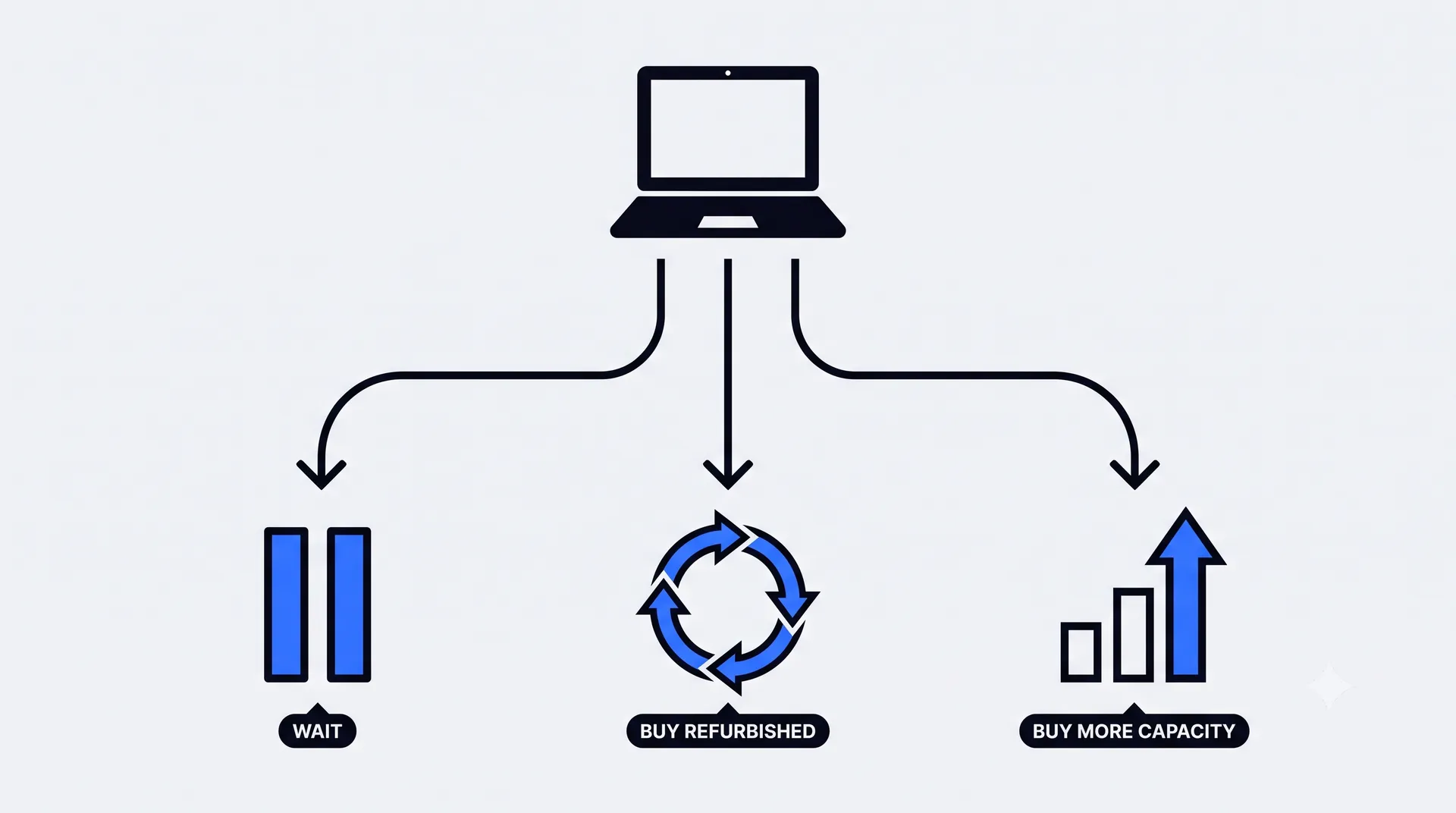
Sweat the hardware you have. If something genuinely must be replaced, look seriously at last-generation and refurbished machines bought before the repricing — Consumer Reports pointed out that a 2020 M1 MacBook Air still handles most work fine at a fraction of current-gen cost, and the same logic applies across brands. Year-over-year improvements have been marginal for a while; 2026 is the year that stops being a boring observation and starts being a purchasing strategy.
How I'd spec a dev machine in 2026
My honest answer: I'd buy as little machine as my actual workload requires, and lean on cloud infrastructure for everything else — because that's already how I build.
CreatorBit runs on Supabase and Vercel. My local machine's job is a Next.js dev server, a browser with too many tabs, a terminal running an AI coding agent, and occasionally Docker. None of that requires a workstation. The heavy lifting — database, auth, edge functions, the LLM behind the AI features — happens on someone else's silicon. I wrote about that architecture choice in Why I Picked Supabase Over Firebase, and the memory crisis has quietly made it a financial argument, not just a developer-experience one: renting infrastructure means the RAM shortage is your provider's procurement problem, amortized across thousands of customers, instead of a four-figure line item on your personal card.
That said, cloud isn't free of this either. Datacenter operators are paying the same inflated memory prices, and those costs eventually flow into VPS and instance pricing. The difference is the blast radius: a gradual price adjustment on a monthly bill is survivable for a bootstrapper in a way a sudden doubled hardware purchase isn't. If you're deciding where your money goes as a solo builder, I'd still put it toward tools and services that compound — I covered my actual list in 5 Tools Every Solo Developer Should Actually Pay For — before I'd put it toward speculative hardware.
If I genuinely had to buy a primary dev machine today, here's the framework:
| Situation | What I'd do |
|---|---|
| Current machine still runs your stack | Don't buy. Wait out 2026. |
| Machine failing, budget tight | Last-gen or refurbished, 16GB minimum |
| Buying new, keeping it 4+ years | Pay for 32GB now — soldered RAM means no second chance |
| Running local LLMs seriously | 64GB+, but ask honestly if cloud inference is cheaper |
| Team/agency buying multiple machines | Buy refurb in bulk now; prices are forecast to keep rising through 2026 |
The one place I would not cut: if the machine is non-upgradeable and you'll keep it past 2028, buy more memory than feels necessary today. Every trend in developer tooling — agents, local inference, heavier browsers, containerization — points toward workflows needing more RAM, not less, and you're buying at the exact moment "add it later" stopped being an option.
When will RAM prices come down
Not soon, and possibly never fully. IDC expects prices to stabilize by mid-2027; Counterpoint identifies Q4 2027 as the earliest inflection point; Intel CEO Lip-Bu Tan has said there will be no relief until 2028; SK Hynix has forecast the crunch could stretch toward 2030. New fab capacity from Micron and SK Hynix doesn't reach volume production until 2027 at the earliest.
The more uncomfortable consensus: several analysts warn prices may never return to 2024 levels, because the capacity reallocation toward AI is permanent, not cyclical. Two things could break the forecast early — a genuine pullback in AI capital expenditure, or memory-efficiency breakthroughs in AI software that reduce demand. I wouldn't plan a purchase around either.
There's one strange silver lining for developers: scarcity forces discipline. Game studios are already talking about the RAM crisis pushing better optimization, and I suspect the same pressure lands on us. The era of "RAM is cheap, ship the Electron app, spin up another container" priced in an assumption that just expired. Software that respects memory is about to be a competitive advantage again.
For more posts like this one, see more Tech & Developer Life posts.
FAQ
Frequently asked questions
Why is RAM so expensive right now?
RAM is expensive because AI datacenters are consuming the majority of global memory production — roughly 70% of output in 2026, per IDC — and the three manufacturers that control about 90% of DRAM supply (Samsung, SK Hynix, and Micron) have shifted factory capacity toward high-margin AI memory like HBM. That leaves a shrinking share of wafers for consumer RAM, and DRAM contract prices rose 50% in late 2025 with further increases of 50–89% per quarter tracked through 2026.
Will RAM prices go down in 2026?
No. Every major analyst forecast points to RAM prices continuing to rise through 2026, with TrendForce projecting increases of around 70% for the year and Gartner projecting memory cost surges on the order of 130%. AI demand exceeds the entire 16% growth in DRAM supply expected for 2026, so the shortage persists all year.
When will RAM prices come back down?
The earliest credible estimates for stabilization are mid-to-late 2027, when new fab capacity from Micron and SK Hynix begins volume production. Intel's CEO has said there will be no relief until 2028, and SK Hynix has warned the shortage could stretch toward 2030. Several analysts also warn prices may never fully return to 2024 levels because manufacturing capacity has been permanently reallocated toward AI memory.
Should I buy RAM or a new laptop now, or wait?
Wait if your current hardware still runs your workload — 2026 is the most expensive time to buy memory in two decades, and same-price laptops are shipping with downgraded specs like 8GB instead of 16GB. If you must buy, choose last-generation or refurbished machines purchased before the repricing, and if the machine has soldered RAM and you'll keep it four or more years, pay for 32GB now because you won't be able to add memory later.
Written by Jenarius Ganlary
Full-stack developer and MIS & Data Analyst, building CreatorBit and freelancing through Ganlary Labs. Writing about SaaS, AI, and startups as it happens.
More about me →KEEP READING